Spanish Army Jefatura de Transmisiones
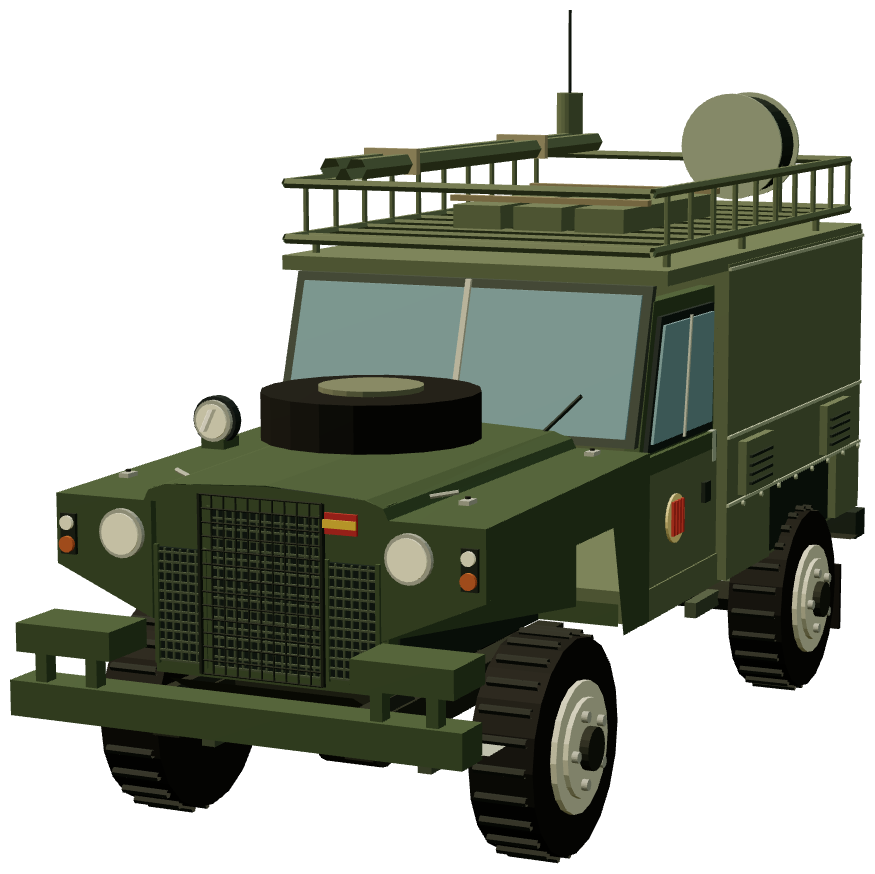
The Spanish Army's signals directorate, created in 1940, which in 1980 devised Programa OLIMPO — a stopgap field communications system assembled from equipment already in stock and mounted on cross-country vehicles. Its Mercurio radio station was installed in the hard-topped signals body of the Santana-built Land Rover 109 ETRS.
History
The Jefatura de Transmisiones del Ejército was created by an Order of 6 February 1940, which brought the Parque Central y Talleres de Transmisiones — the Army's central signals park and workshops — under a single new headquarters; the park was re-established as an independent unit on 1 February 1941 and survives today as the Parque y Centro de Mantenimiento de Material de Transmisiones in Madrid. The Jefatura was the directorate responsible for the Spanish Army's communications equipment, its standards and its fielding.
Its appearance in this registry comes from Programa OLIMPO, which entered service in 1980 as an emergency plan. The Army's first attempt at a tactical digital network, RADITE, had been in development since 1969 and was falling badly behind — it was finally cancelled in 1991 — while equipment ordered from the United States in 1977 would not be delivered in full until 1984. Rather than wait, the Jefatura de Transmisiones built a provisional system out of equipment already held in store, standardised the internal layout of signal centres across the Army, and mounted the resulting stations on cross-country vehicles: Land Rover 109s first, later shelters and BMR and TOA armoured vehicles. The stations were named after gods — Hermes, Minerva, Centauro, Tritón, Plutón, Ceres and Mercurio.
The Mercurio was the pure radio station of the family, carried in the Santana LR-109 ETRS signals body and issued to battalion command posts and to division and brigade signal centres. Its Type B fit paired a 400 W ELMER SRT-470 HF set with a 30 W VHF radio and a Siemens T-1000 teleprinter on a 3 kW generator, worked by a crew of three, and could operate on the move. Intended as a stopgap, OLIMPO stayed in service for roughly two decades.
The Jefatura de Transmisiones does not exist under that name today, but no source traced during this research establishes when or how it ended. The Army's communications functions are now divided between the Jefatura de los Sistemas de Información, Telecomunicaciones y Asistencia Técnica (JCISAT), which marked its twentieth anniversary in 2025, and the signals units of the Brigada de Transmisiones of 2001, renamed Mando de Transmisiones in January 2016 with headquarters at Bétera, Valencia; whether either is a formal successor is not stated in the sources found.
Vehicles in this registry (1)
Sources & citations
- Historial del Parque y Centro de Mantenimiento de Material de Transmisiones (Orden de 6 de febrero de 1940 creando la Jefatura de Transmisiones del Ejército, en la que se integra el Parque Central y Talleres de Transmisiones; Parque Central de Transmisiones como unidad independiente el 1 de febrero de 1941) ↗ — Ejército de Tierra, Ministerio de Defensa (Spain) (accessed 2026-09-10)
- OLIMPO: la provisionalidad que duró dos décadas (the Jefatura de Transmisiones assembled a provisional system from equipment in stock in 1980, standardised signal-centre layouts and mounted the stations on Land Rover 109s; RADITE under development from 1969 and cancelled in 1991; stations named Hermes, Minerva, Centauro, Tritón, Plutón, Ceres and Mercurio) ↗ — Radio Militar (accessed 2026-09-10)
- Mando de Transmisiones del Ejército de Tierra de España (Brigada de Transmisiones creada por Orden Ministerial 263/2001; renombrada Mando de Transmisiones en enero de 2016; cuartel general en Bétera, Valencia) ↗ — Wikipedia (Spanish) (accessed 2026-09-10)
- Jefatura de los Sistemas de Información, Telecomunicaciones y Asistencia Técnica (JCISAT) — the Army body responsible for information systems and telecommunications ↗ — Wikipedia (Spanish) (accessed 2026-09-10)
Maker record updated 2026-09-10T05:40:28.275Z · status: researched