Series II Ambulance
The Australian Army's four-stretcher "Bloodbox" — a 109-inch Land Rover carrying a tall, insulated aluminium medical body designed by the Army Design Establishment and built by Pressed Metal Corporation in Sydney. 184 were delivered between 1959 and 1967 on Series 2 and Series 2A chassis, and the type served from 1961 until the mid-1990s.
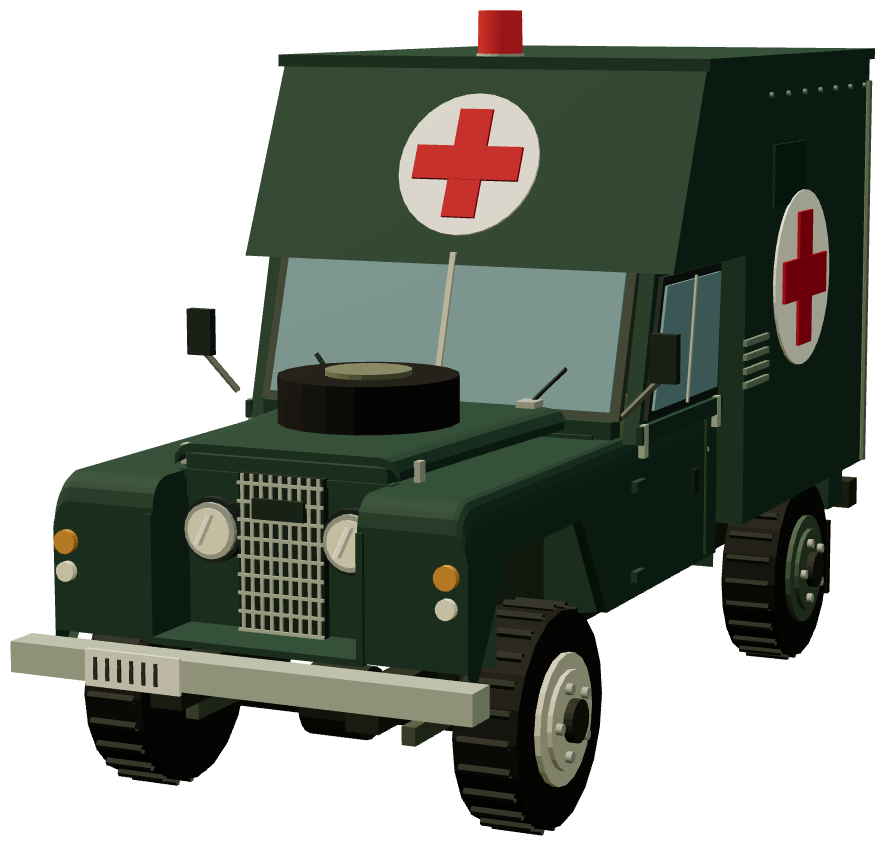
Factory colours
- Deep Bronze Green
- Australian Olive Drab (lustreless)
- Ambulance White
Codes on hover. Hex values are representative approximations of period paint unless a source states a measured value.
History
Australia's post-war tactical ambulances were wartime Canadian Military Pattern trucks, and by 1956 the fleet was worn out. A new specification drafted late that year called for a lighter 1-ton 4x4 suited to South East Asian deployments. The Army Design Establishment at Maribyrnong first worked up an International Harvester-based design (project V150), but after an Australian officer was shown the new ¾-ton 109-inch Series 2 in Britain in June 1958, a comparative study led to a meeting on 12 August 1958 agreeing that a Land Rover-based ambulance was the better proposition on size, weight and cost. A full-size mock-up was viewed on 27 February 1959 and enthusiastically endorsed by the Director General of Medical Services, and all further work concentrated on the 109-inch chassis. Mike Cecil, then Head of Military Heraldry and Technology at the Australian War Memorial, established from the ADE files that the ambulance design actually preceded the Army's decision to adopt the long-wheelbase Land Rover as its ¾-ton GS truck, correcting the common belief that it followed on from it.
Two pilot models were built to ADE specification by the Pressed Metal Corporation of Enfield, Sydney — the firm that assembled Rover's CKD kits in Australia — during the second half of 1959, and were shown at ADE on 18 December. One had a fully insulated, lined aluminium body with 'Coolite' insulation between the skins and full-height rear doors; the other, the "Indian Pattern", had an uninsulated body and a nylon-fabric rear flap. Both were sent on a 5,000-mile hot-wet and hot-dry route reconnaissance from Maribyrnong to Innisfail, Alice Springs and back between January and April 1960. The trials condemned the ventilation and the vehicles' performance on grades, and produced the cut-away front mudguard that became standard on all Australian Army Land Rovers; they also produced one memorable experiment when the reworked prototype was sent out in 1961 with its rear body painted gloss white, which recorded far lower surface temperatures than Deep Bronze Green but was rejected as untactical. The insulated body was accepted, and an interim order for 31 vehicles on Series 2 chassis (Contract C107028) was delivered to 2 BOD, Moorebank, by June 1961.
Five further orders followed on the improved Series 2A chassis, the last delivered late in 1967, giving 151 Series 2A vehicles and a total fleet of 184 including the two pilots and the 31 Series 2s. The registry model is dated 1963, which sits on the boundary between the two chassis lines: REMLR's ARN/chassis data list for census 6362 dates every 1963 delivery to the Series 2A batches (ARN 108-640 to 108-650 and 112-209 to 112-242), while the Series 2 cars are all recorded as 1959 or 1961 — so a Bloodbox in service from 1963 is either an early Series 2A or a 1961-built Series 2 taken on charge two years later. Both are commonly described simply as "Series 2 ambulances" in Australia, and the registry's reference vehicle at cars.jo.je is identified by its owner as a 1963 Series 2 that served until 1993; this record is filed under the Series 2 line while covering the whole type. Mechanically the ambulance was standard Australian military specification: the 2,286 cc four-cylinder petrol engine with twin fan belts, four-speed gearbox with two-speed transfer case, twin fuel tanks, brushguard, bonnet-mounted spare, cut front guards and 7.50-16 bar-tread crossplies, with a Land Rover capstan winch on many vehicles and 11-leaf front springs to carry the body. Extras included a Smiths cabin heater, demister, heavy-duty alternator, roof skylight and vents, over-cab and side lockers, and a revolving red roof beacon — vulnerable enough that some vehicles gained a wire cage over it. The rear door seals were notoriously poor and let exhaust fumes into the patient compartment, which did nothing for the nickname.
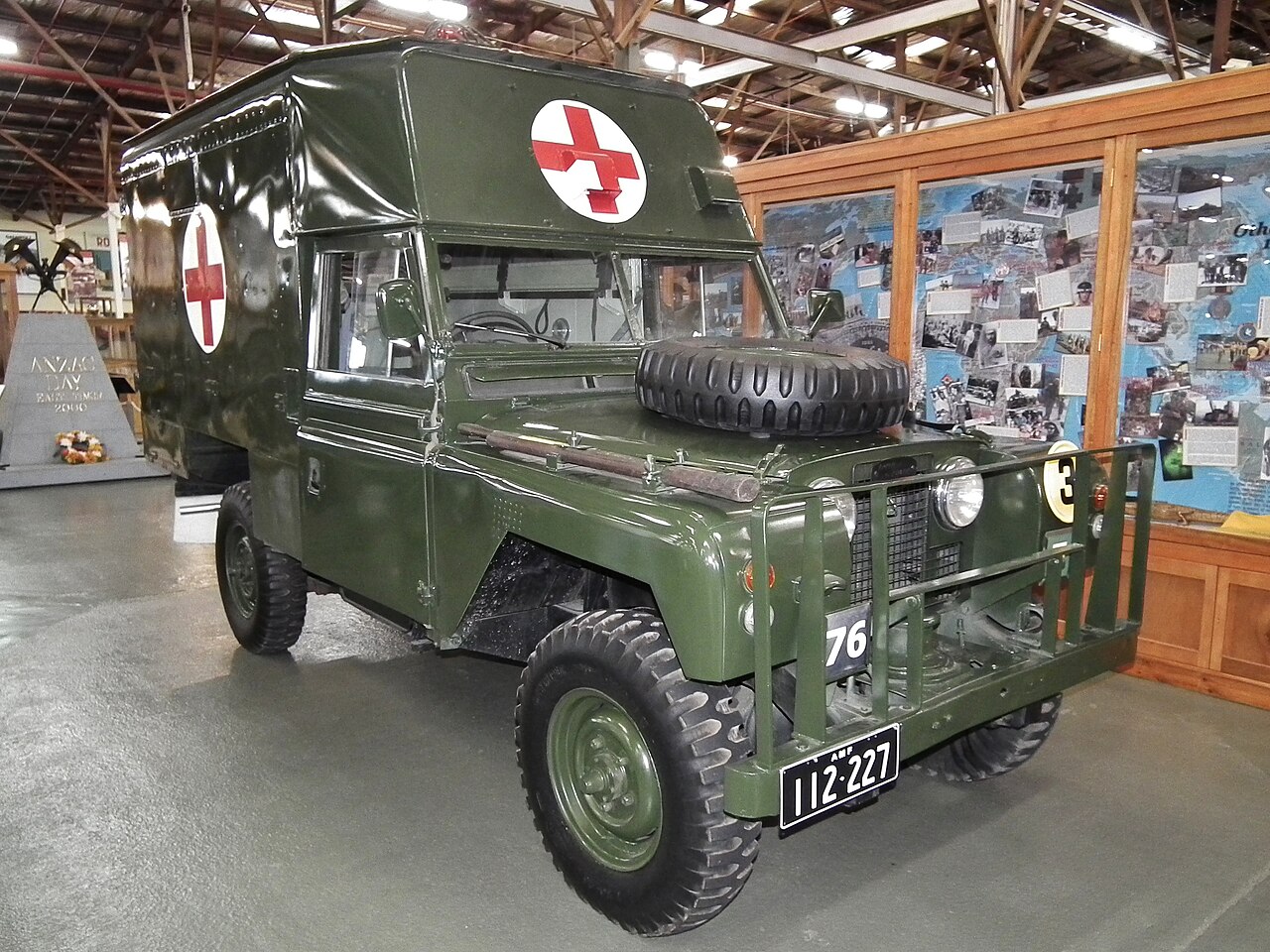
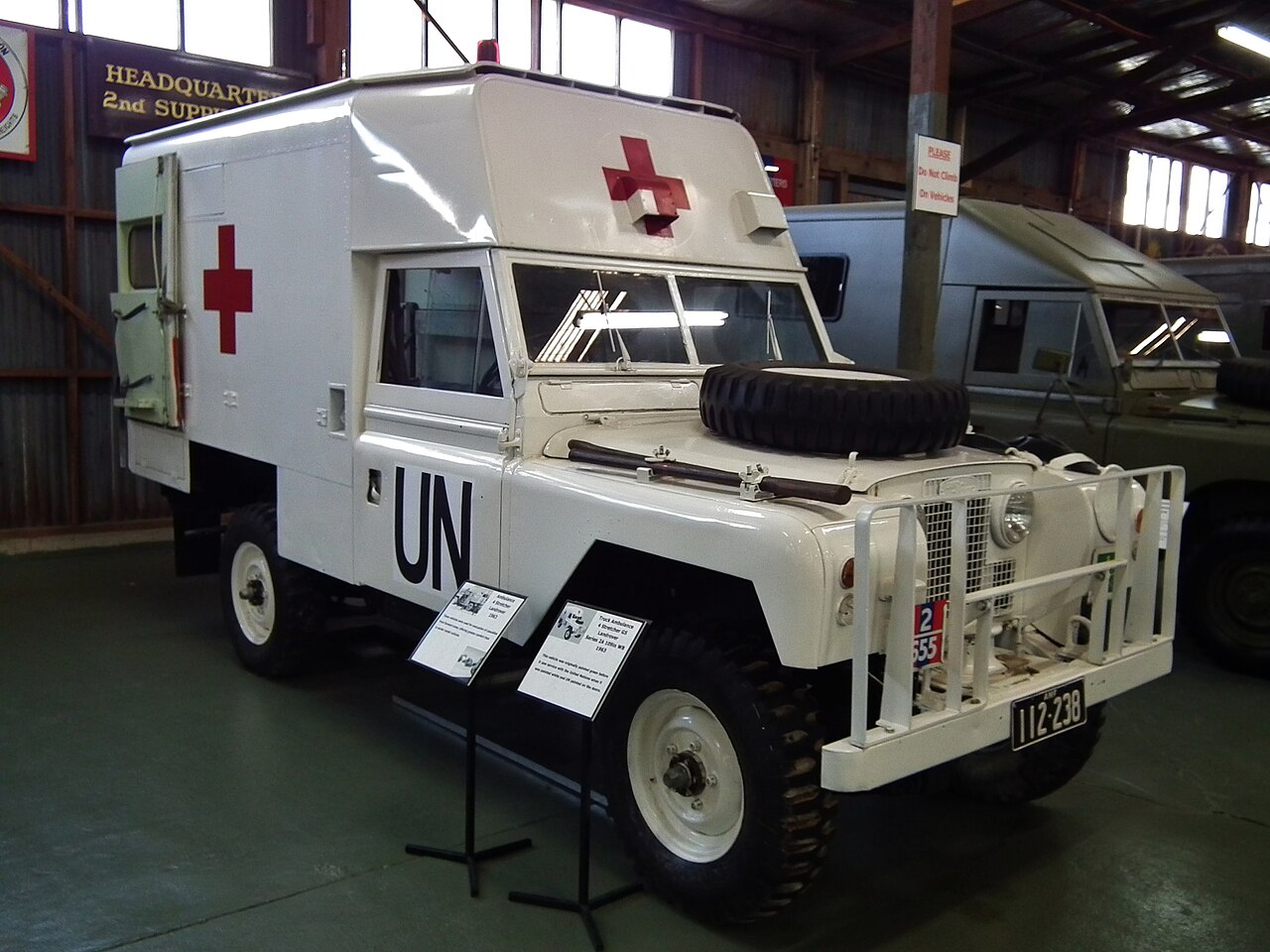
Named the "Blood Box" by the soldiers who rode in it, the type served the Royal Australian Army Medical Corps around Australia and in South Vietnam, where Land Rover ambulances worked with 2 Field Ambulance at Vung Tau and later units, running casualty transfers and village and orphanage clinics. Early vehicles wore gloss Deep Bronze Green with red crosses in white discs on the body sides and roof; from April 1967 the fleet followed the Army's change to lustreless Olive Drab. Disposals began in 1971-74 with three batches transferred to the Department of Foreign Affairs for the aid programme and two sold to New Zealand, but the fleet was long-lived: a few were converted to interim Electrical Repair Vehicles in the late 1980s, and by 1993 only two Series 2 and seven Series 2A ambulances remained before the Perentie 6x6 ambulance replaced them. Survivors are well represented in museums: the Army Museum Bandiana in Victoria displays ARN 112-227 in bronze green and ARN 112-238 in the white UN scheme it wore with the Australian contingent in Cambodia in the early 1990s, the Australian War Memorial holds a Series 2A four-berth ambulance bought on charge in 1963 and disposed of by 21 Supply Battalion in December 1983 (REL/10136), and others are in private preservation.
Imagery
.jpg)
.jpg)
Registry record
- Manufacturer
- The Rover Company (109-inch Series 2/2A chassis)
- Manufactured
- 1959 pilot models; production deliveries 1961–1967
- Modifier / coachbuilder
- Pressed Metal Corporation, Enfield, Sydney (body built to Army Design Establishment design) ↗
- Engine type
- 2.25 L (2,286 cc) petrol inline-four, Australian military specification with twin fan belts
- Production run
- 184 vehicles (2 pilot models, 31 on Series 2 chassis, 151 on Series 2A chassis)
- Country of origin
- Australia
- Status
- retired by the mid-1990s; preserved at the Army Museum Bandiana, the Australian War Memorial and in private hands
Catalogue data
- Record kind
- Named model
- Model line
- Series II
- Wheels
- 4
Base catalogue fields are exported from the Difflocked game. In-game physics values are arcade tuning, not certified historical measurements, and are deliberately not shown as specifications here.
Sources & citations
Researched sources
- Blood Box: The Australian Land Rover Series 2 and 2A, 4-Stretcher Ambulance (development from 1956, ADE project V150, 1959 pilot models by Pressed Metal Corporation, 1960 and 1961 trials, 31 Series 2 and 151 Series 2A, 184 total, Vietnam service, disposals to the mid-1990s, ARN and contract tables) ↗ — Mike Cecil, via Registry of Ex-Military Land Rovers (REMLR) (accessed 2026-09-10)
- Series 2A Ambulance (body by Pressed Metal Corp Sydney, double-skinned aluminium with foam insulation, roof beacon, skylight and vents, twin rear doors; 2286 cc four with double pulleys, 11-leaf front springs, capstan winch, Smiths heater; "Blood-box" nickname; UN white example at Bandiana) ↗ — Registry of Ex-Military Land Rovers (REMLR) (accessed 2026-09-10)
- Census 6362, Ambulances — all Series 2 and 2A Ambulances ARN/chassis data list (per-vehicle chassis, contract, year and disposal; 1963 deliveries all Series 2A; ARN 112-227 and 112-238 at Army Museum Bandiana; ARN 108-645 in storage at AWM) ↗ — Registry of Ex-Military Land Rovers (REMLR) (accessed 2026-09-10)
- Land Rover 2A Ambulance (Australia), REL/10136 — four-berth ambulance, Rover with local bodywork, ARN 109 645, bought on charge 1963, disposed of by 21 Supply Battalion 16 December 1983; 82 Series 2A ambulances on charge by 1968; used in South Vietnam by 2 Field Ambulance at Vung Tau ↗ — Australian War Memorial (accessed 2026-09-10)
- Australian Army Vehicle Colour Schemes and Paint (gloss Deep Bronze Green to lustreless Olive Drab from April 1967) ↗ — Registry of Ex-Military Land Rovers (REMLR) (accessed 2026-09-10)
- 1963 Land Rover Series 2 Ambulance (the registry's reference vehicle: bought 2020, in Army service 1963–1993, restoration notes, factory dual-pulley alternator) ↗ — cars.jo.je (accessed 2026-09-10)
- Series 2 109 Bloodbox (both pilot models survived into civilian hands; the 31 pre-production Series 2 vehicles differed slightly from the 151 production Series 2A units) ↗ — Registry of Ex-Military Land Rovers (REMLR) (accessed 2026-09-10)
Development reference notes
MMB Defender 130 St John ambulance · HERITAGE-FLEET-REFERENCES.md
Tall square medical body; side patient access; ambulance lighting and markings. Reference: https://www.lrheritagecollection.org.uk/the-collection/vehicles/svc-01
Marshall ambulance family — marshal-ambulance, meteor-works, raf-marshall-rescue · HERITAGE-FLEET-REFERENCES.md
The Series IIA 109-inch Marshall ambulance body is shared by the army ambulance, Meteor Works (Fan Favourites), and RAF Crash Rescue variants. The shared shell has an extended rear overhang, a broad low roof with rounded eaves, high side windows, paired rear doors, and a closed angled lower rear panel sweeping upward behind the rear wheel. The additional `images.jpeg` rear photograph establishes the full-width sloping panel, central folded hatch, recessed paired lamps and lower round reflectors; no deployed horizontal step is shown. Preserve these common body features when adding further liveries. RAF Crash Rescue uses the user-supplied TRP 291G photographs: dark blue body, yellow roof, waist stripes and bumper, white/red medical panels, CRASH RESCUE brow lettering, ROYAL AIR FORCE side lettering, amber roof beacon, paired blue front lamps, aerials and an outboard searchlight. Listed under UK military and Special Vehicles rescue/ambulance. Reference files supplied by the user: `imagesg.jpeg`, `imagesgdsgds.jpeg`, `kkk.jpeg`, `imagesll.jpeg`, `e6e0e10c51677d4b1471d6c1dc1de9cagdgs.jpeg`, and `imageshh.jpeg`. The final photograph also illustrates a later Series III Marshall-bodied ex
101 Forward Control ambulance · MILITARY-MODEL-REFERENCES.md
- [Production ambulance photographed by Steve Glover, 1981 vehicle](https://commons.wikimedia.org/wiki/File:Land_Rover_101_Forward_Control_Ambulance_(1981).jpg): split raked screen, separate medical body, projecting roof brow, twin corner vents, low headlamps, central grille, steps and rear doors. - [Dunsfold Collection's prototype ambulance](https://dunsfoldcollection.co.uk/collection/101-forward-control-ambulance/): useful side/body reference; its large overhead grille differs from the production front used here. - [Factory 101 manual](https://www.landroverweb.com/Pdf-files/Manuals/Land_Rover_101_Forward_Control_Manual.pdf): 101-inch chassis. Model and physics use 2.5654 m axle spacing.
[Land Rover ambulance dimensions](https://www.landrover.es/content/dam/lrdx/pdfs/es/711389_L316_15MY%20AVM_110_130_AMBULANCE%206pp.pdf): 130 chassis-cab ambulance layout and 1,790 mm cab width / 1,486 mm track reference. · DEFENDER-PROPORTIONS.md
- [Land Rover ambulance dimensions](https://www.landrover.es/content/dam/lrdx/pdfs/es/711389_L316_15MY%20AVM_110_130_AMBULANCE%206pp.pdf): 130 chassis-cab ambulance layout and 1,790 mm cab width / 1,486 mm track reference.
[Production ambulance photographed by Steve Glover, 1981 vehicle](https://commons.wikimedia.org/wiki/File:Land_Rover_101_Forward_Control_Ambulance_(1981).jpg): split raked screen, separate medical body, projecting roof brow, twin corner vents, low headlamps, central grille, steps and rear doors. · MILITARY-MODEL-REFERENCES.md
- [Production ambulance photographed by Steve Glover, 1981 vehicle](https://commons.wikimedia.org/wiki/File:Land_Rover_101_Forward_Control_Ambulance_(1981).jpg): split raked screen, separate medical body, projecting roof brow, twin corner vents, low headlamps, central grille, steps and rear doors.
[Dunsfold Collection's prototype ambulance](https://dunsfoldcollection.co.uk/collection/101-forward-control-ambulance/): useful side/body reference; its large overhead grille differs from the production front used here. · MILITARY-MODEL-REFERENCES.md
- [Dunsfold Collection's prototype ambulance](https://dunsfoldcollection.co.uk/collection/101-forward-control-ambulance/): useful side/body reference; its large overhead grille differs from the production front used here.
101 Forward Control ambulance · MILITARY-REFERENCES.md
- 101 Forward Control ambulance: https://dunsfoldcollection.co.uk/collection/101-forward-control-ambulance/ — cab-over layout, overhead ventilation grille; rear photo RGN239P-2.jpg used for door windows and medical panel.
Drive it
This vehicle is playable in the Difflocked racing game.
RACE THE SERIES II AMBULANCE ↗Registry record updated 2026-09-10T02:19:59.445Z · status: researched