Series II 109
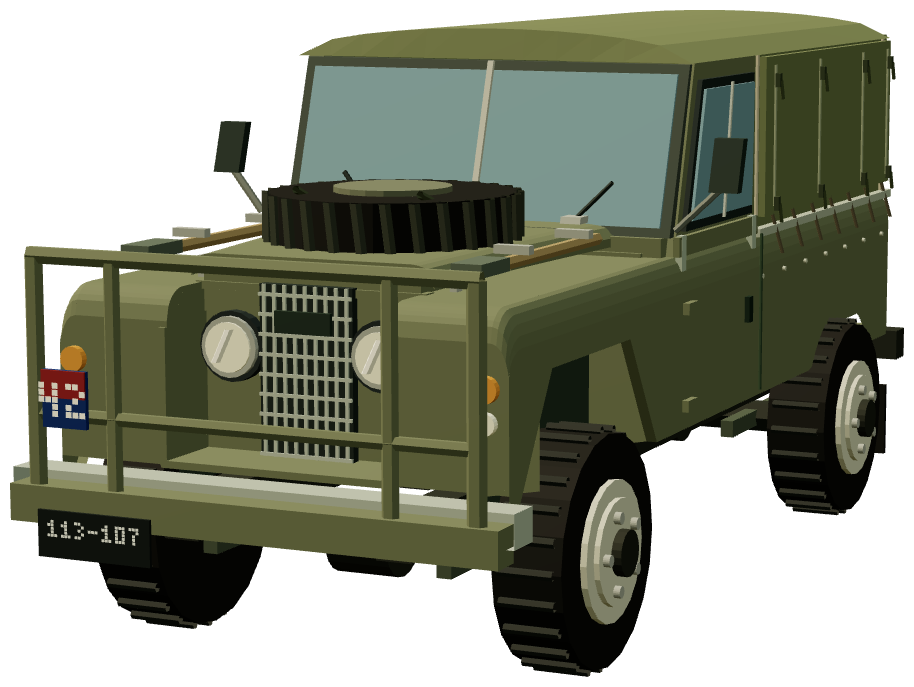
General-service 109″ Land Rovers of the Australian Army, bought from around 1960 as near-civilian Series 2s and then as heavily modified Series 2A ¾-ton GS trucks, locally assembled at Pressed Metal Corporation in Sydney and worked from Vietnam-era training areas to the outback.
Factory colours
- Deep Bronze Green
- Australian Olive Drab (lustreless)
Codes on hover. Hex values are representative approximations of period paint unless a source states a measured value.
History
The Australian Army standardised on the long-wheelbase Land Rover as its light truck in the Series 2 era. The first Series 2 109s, in service from around 1960, were what the Registry of Ex-Military Land Rovers (REMLR) describes as "more-or-less civilian" vehicles, while the Series 2A ¾-ton units supplied from 1963 to 1966 went mainly to specialty conversions — ambulances, fire tenders, survey and workshop bodies — before the definitive Series 2A ¾-ton GS (census 6028) arrived in numbers around 1966–67. Like most Australian-market Land Rovers of the period, the Army's vehicles were assembled from knocked-down kits by Pressed Metal Corporation at Enfield in Sydney, which had held the Rover assembly contract since the mid-1950s and continued building Land Rovers into the 1980s; REMLR records both four- and six-cylinder 109s coming through Pressed Metal Corporation as late as 1971–72.
The Army-pattern GS trucks differed substantially from civilian 109s. The chassis gained extended front spring mounts and rear shackles for extra ride height, an extra outrigger carrying a duplicate 10-gallon fuel tank, longer shock absorbers and 7.50-16 tyres, while the 2.25-litre petrol engine ran twin fan belts. Exterior fittings included the characteristic brushguard ("bull bar"), bridge-classification plate, blackout light, pioneer-tool brackets, NATO trailer socket, twin fuel fillers and a canvas strap for the folded windscreen — the canvas-tilted, bull-barred silhouette the registry model reproduces. Some 109s carried an Army-specification PTO winch made by Bamfords of Victoria.
Early vehicles were delivered in gloss Bronze Green enamel (the British Deep Bronze Green standard); from April 1967 the fleet was over-sprayed in the Australian Army's own flat, infrared-reflective Olive Drab, with white-painted bumper corners and rear diff for convoy work and stencilled load-sign markings. The Series 2 and 2A 109s soldiered on through the Vietnam era and beyond until progressively replaced by Series 3 and, from 1987, Perentie 110 fleets; many survive with collectors and in unit museums.
Registry record
- Manufacturer
- The Rover Company (CKD kits assembled by Pressed Metal Corporation, Enfield, Sydney)
- Manufactured
- circa 1960–1972 (Series 2, then Series 2A supply)
- Engine type
- 2.25 L petrol inline-four (Army spec with twin fan belts; some later 2A lots six-cylinder)
- Country of origin
- United Kingdom (assembled in Australia)
- Status
- retired; survivors preserved by collectors and army museums
Catalogue data
- Record kind
- Named model
- Model line
- Series II
- Wheels
- 4
Base catalogue fields are exported from the Difflocked game. In-game physics values are arcade tuning, not certified historical measurements, and are deliberately not shown as specifications here.
Sources & citations
Researched sources
- Series 2A 109 GS (Australian Army ¾ ton GS: chassis modifications, fittings, gloss Bronze Green then flat Olive Drab, service dates) ↗ — Registry of Ex-Military Land Rovers (REMLR) (accessed 2026-09-10)
- Australian Army Vehicle Colour Schemes and Paint (April 1967 change from gloss Deep Bronze Green to lustreless Olive Drab) ↗ — Registry of Ex-Military Land Rovers (REMLR) (accessed 2026-09-10)
- Who assembled the Landys in OZ (Pressed Metal Corporation, Enfield, Sydney; Rover assembly contract from the mid-1950s; 4- and 6-cylinder 109s assembled 1971-72) ↗ — AULRO forum (accessed 2026-09-10)
- Pressed Metal Corporation ↗ — Wikipedia (accessed 2026-09-10)
- Land Rover Series 2A, 3/4 ton General Service (museum object record for the successor 2A GS type) ↗ — Australian War Memorial (accessed 2026-09-10)
Drive it
This vehicle is playable in the Difflocked racing game.
RACE THE SERIES II 109 ↗Registry record updated 2026-09-09T15:13:03.351Z · status: researched