Carawagon
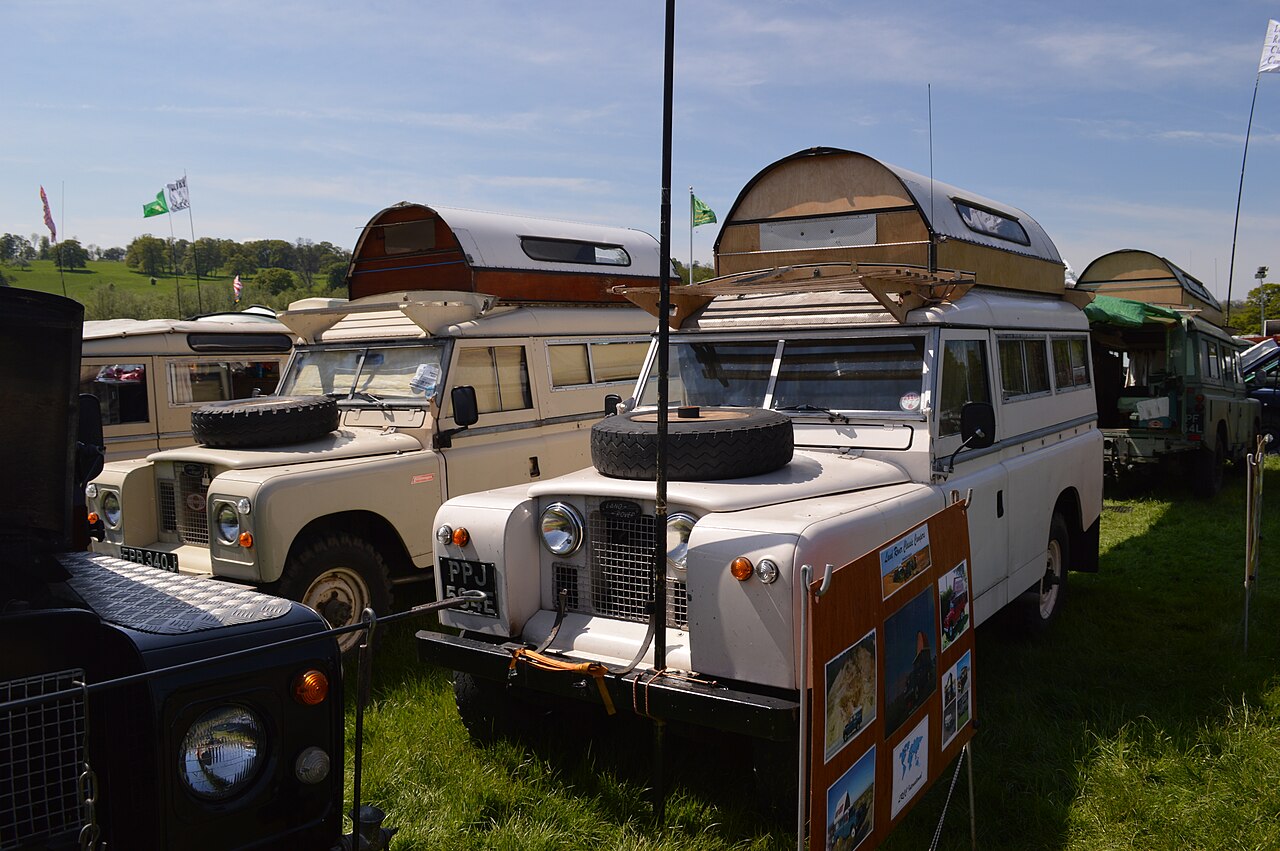
The civilian Carawagon: the Land Rover 109 Station Wagon turned into a four-berth camper by R. J. Searle Ltd of Sunbury-on-Thames, identified by a full-length elevating roof of aluminium and marine plywood that bows into a cathedral arch to give 6 ft 2 in of standing headroom. About 2,500 Land Rovers were converted between the early 1960s and the mid-1980s.
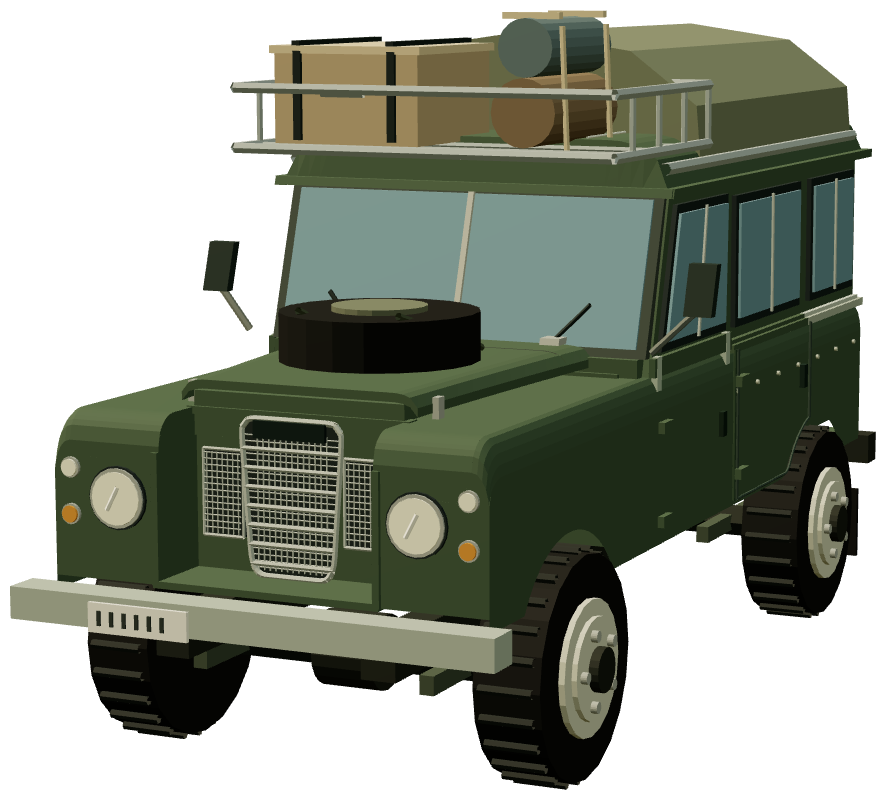
Factory colours
- Pastel Green
- Limestone
- Marine Blue
- Bronze Green
Codes on hover. Hex values are representative approximations of period paint unless a source states a measured value.
History
R. J. Searle Ltd of Sunbury-on-Thames were boatbuilders first, which shows in the Carawagon: the roof that defines it is a flexible aluminium sheet on marine plywood formers, lying flat in transit and springing into a full-length arch when raised, with hinged end panels that fold inside. Raised, it gives 6 ft 2 in of headroom down the whole vehicle — enough to stand and cook in — and a short roof rack usually sits above the cab. Not every Carawagon had it: some were built with a fixed roof and a full-length rack instead.
Searle worked across the Land Rover range from the early 1960s to the mid-1980s. The 109-inch five-door Station Wagon was the mainstay, the 109 three-door was common, and the 88 was offered but rarely taken; a handful of two-door Range Rovers were converted too. The body modifications were approved by Land Rover: the rear side benches were reworked, the wheel wells cut into for storage, and on three-door vehicles the bulkhead behind the front seats was removed to open the interior end to end.
Inside, the standard arrangement was either twin opposing rear benches converting to two beds with a removable table between them, or a single bench on the left facing a cabinet on the right. Both came with a storage cupboard, a sink fed by hand or foot pump from a nine-gallon tank, a two-burner stove and grill usually mounted inside the rear door and folded away for travel, and fluorescent lamps. Folding front seats made another double, and four-berth cars added two roll-out hammock bunks. The options list ran to a dual-fuel refrigerator, dual batteries, a fuel-fired heater, air conditioning, fly screens, a portable toilet, and a rear awning on an extending slide-out frame. Everything was built to order, so no two are quite alike, and Searle sold them under model names — the 109 'Ultimate', the two-berth 'Continental', the 'Ulysses' on the 110, and the 'Safari 88'.
Carawagons were bought to be used hard. Most of the survivors have expedition histories, which is the main reason so few remain from a run of roughly 2,500. A 1968 Series IIA 109 with the 2.6-litre straight-six went from the Solihull production line straight to Searle for conversion; a 1972 Series III 109 four-berth in Pastel Green, LPD 606K, survives with its original Carawagon order correspondence and itemised invoice alongside a fuel log its first owner kept for 37 years and 155,000 miles, averaging 18.71 mpg. The firm later traded as Carawagon International.
The Ministry of Defence ordered around 34 as tactical command and control vehicles, which became the separate Military Carawagon: same elevating roof, but with blackout curtains, dark glass, a single side window and a camouflage-net rack over the cab. Searle's chief rival in the Land Rover camper trade was Martin Walter of Folkestone, whose Dormobile took the same idea in a different direction with its side-hinged elevating roof.
Imagery
.jpg)
Registry record
- Manufacturer
- Land Rover (Rover Company / British Leyland), 109-inch Station Wagon donors
- Manufactured
- conversions from the early 1960s to the mid-1980s
- Modifier / coachbuilder
- Searle Ltd (Carawagon) ↗Sunbury-on-Thames, later Carawagon International Ltd
- Engine type
- 2.25 L petrol inline-four or 2.6 L petrol inline-six, as specified on the donor Station Wagon
- Production run
- ~2,500 Land Rovers converted
- Country of origin
- United Kingdom
- Status
- out of production; survivors in private hands, many with expedition histories
Catalogue data
- Record kind
- Named model
- Model line
- Series III
- Wheels
- 4
Catalogue fields describe the vehicle's structure and body as this registry records it. They are not certified factory measurements, and no performance figures are published here.
Sources & citations
Researched sources
- Camper conversions — Carawagon: R. J. Searle Ltd of Sunbury on Thames (principally boatbuilders), 1960s to mid-1980s; donors converted, Land Rover-approved body modifications, elevating roof construction and 6 ft 2 in headroom, interior layouts, options list and the 'Ultimate', 'Continental', 'Ulysses' and 'Safari 88' model names ↗ — Guide to Land Rover camper conversions (accessed 2026-09-10)
- Carawagon — R. J. Searle Ltd of Sunbury on Thames made Carawagon camper conversions of vans, Land-Rovers and Range Rovers, and were a competitor to Dormobile ↗ — allisons.org (accessed 2026-09-10)
- 1968 Land Rover Series IIA 109 Carawagon — 'Just 2,500 or so Land Rovers benefitted from the Searle Carawagon conversion'; 2.6-litre straight six, delivered from the factory direct to R. J. Searle for conversion ↗ — The Market by Bonhams (auction listing) (accessed 2026-09-10)
- LPD 606K — 1972 Series III 109 Searle four-berth Carawagon in Pastel Green: a genuine civilian Carawagon by Searle / Carawagon International Ltd, with the original Carawagon order letters and itemised invoice and the first owner's fuel log (1972–2009, average 18.71 mpg) ↗ — Land Rover Centre (accessed 2026-09-10)
- The Military Carawagon — Searle Ltd of Sunbury had converted Land Rovers for many years before the military contract; the elevating arched roof described, and the MoD order of around 34 command vehicles ↗ — Ex-Military Land Rover Association (accessed 2026-09-10)
- Land Rover Carawagon — a genuine civilian four-berth Carawagon by Searle / Carawagon International Ltd on a 1970 Series IIA 109: elevating roof giving 6 ft 2 in headroom, convertible bench, bunk beds, cooker with grill, sink and dual-fuel refrigerator ↗ — defender-landrover.co.uk (accessed 2026-09-10)
Catalogue references
- https://emlra.org/articles/vehicles/the-military-carawagon https://emlra.org/articles/vehicles/the-military-carawagon ↗
Development reference notes
Military Carawagon command vehicle · HERITAGE-FLEET-REFERENCES.md
Raised camper-style roof; military paint; command-post equipment. Reference: https://emlra.org/articles/vehicles/the-military-carawagon
Registry record updated 2026-09-10T12:05:44.678Z · status: researched