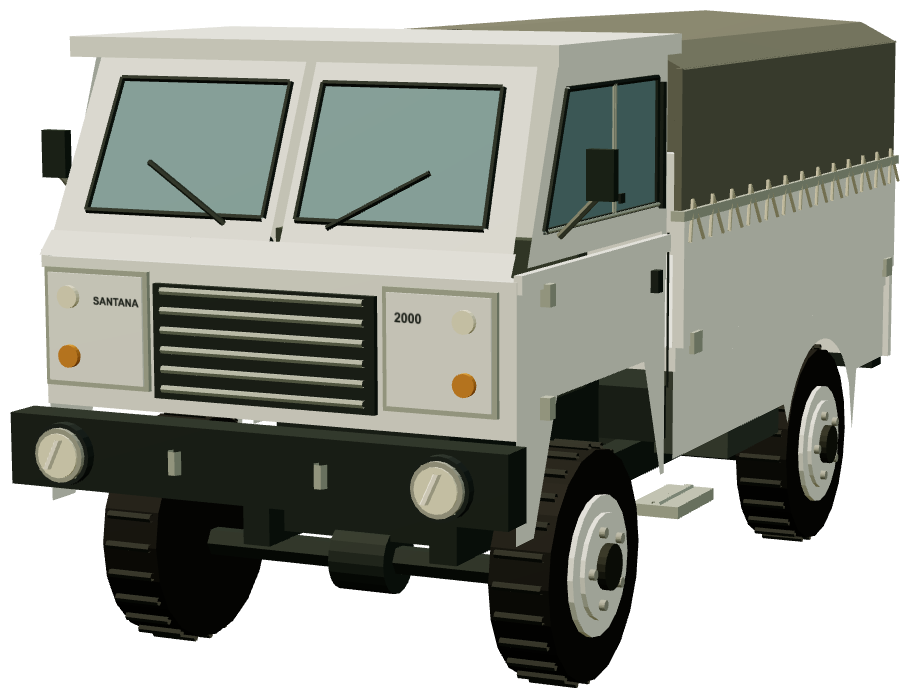
Santana 2000 FC Soft Top
Enlarged forward-control Santana that replaced the 1300 at the end of the 1970s, carrying two tonnes on a Santana-developed 3.4-litre six-cylinder engine. Sold mainly as a chassis-cab for bodying — tippers, tankers, cranes, snowploughs, insulated vans, double cabs seating up to eight, and motorhome conversions.
Variants
of this base modelFactory colours
pick one to repaint the rendersCodes on hover. Hex values are representative approximations of period paint unless a source states a measured value.
History
Santana Motor began as Metalúrgica de Santa Ana, S.A., registered at Linares in the province of Jaén on 24 February 1955 to build agricultural machinery with Spanish government support. An agreement with Rover followed within a year, and the first Spanish-built Land Rovers reached the market in 1958; the licence relationship ran until about 1990. By the 1970s Linares was designing its own derivatives rather than simply assembling Solihull's, among them the 88 Ligero military light 4x4, the five-door 109 Rural Taxi, six-cylinder engines of Spanish design and the forward-control 1300 truck of 1967.
The 2000 was the 1300's replacement, and it followed the same recipe on a bigger scale: a Land Rover Santana 109 chassis and running gear with the cab moved forward over the engine to leave the longest possible load area behind it. The payload rose from 1.3 to 2 tonnes, and the name recorded it. AROnline's Santana timeline places the changeover in 1978; Spanish enthusiast sources date the public presentation to February 1979, and the Spanish Wikipedia model list gives 1981, so the exact launch date is reported inconsistently. Production is generally said to have ended in 1986.
What set the 2000 apart from the four-cylinder 1300 was its engine: the six-cylinder unit of about 3.4 litres (3,429 cc) that Santana had developed in-house and first fitted to 109-inch models from the mid-1970s. Reported outputs are around 104 CV for the petrol version and 94 CV at 4,000 rpm with 309 Nm at 1,800 rpm for the diesel — modest figures, but matched to a low-geared, permanently rough-road brief. Santana marketed the vehicle above all as a chassis with cab, so that each customer could specify the body: tipper, tanker, crane, snowplough, insulated van and box bodies were all built on it, and a double cab seating four to eight was offered alongside the two-seat cab. Its compact dimensions and genuine cross-country ability also made it a favourite base for autocaravana conversions, where the forward-control layout gave an unusually roomy habitation box for the overall length.
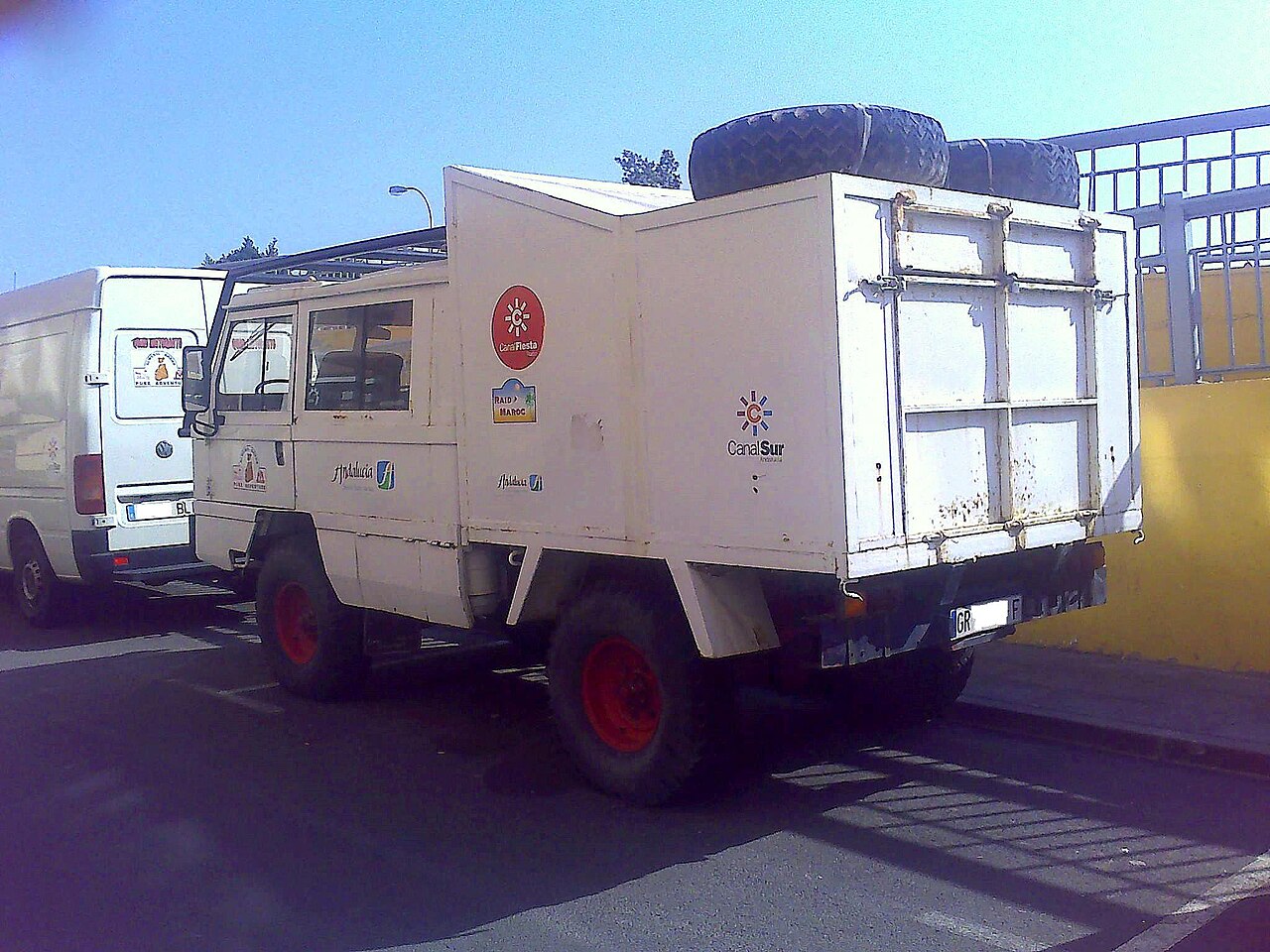
No production figures for the 2000 appear to have been published, and it is by some margin the least-known of the Linares forward-control models — survivors turn up in Spain in expedition and support-vehicle guise more often than in original commercial trim. Santana itself moved on: Suzuki took a stake in 1982 and the Japanese models became the core business, Land Rover-badged production ended around 1990, and the company's own Santana 2500 and PS-10/Aníbal carried the Linares name until the Junta de Andalucía closed the factory in 2011.
Imagery

Registry record
- Manufacturer
- Santana Motor / Land Rover Santana, S.A. (Linares, Jaén, Spain)
- Manufactured
- 1978–1986 (launch variously reported as 1978, February 1979 or 1981)
- Engine type
- 3.4 L (3,429 cc) Santana six-cylinder; petrol reported at about 104 CV, diesel at about 94 CV / 309 Nm
- Country of origin
- Spain
- Status
- out of production
Catalogue data
- Record kind
- Base model
- Model line
- Santana
- Family
- santana2000
- Wheels
- 4
- Body style
- Canvas soft top
- Variants
- 4
Base catalogue fields are exported from the Difflocked game. In-game physics values are arcade tuning, not certified historical measurements, and are deliberately not shown as specifications here.
Sources & citations
Researched sources
- Santana – the story of the Spanish-built Land Rover Defender (Santana timeline, 1958–2011) ↗ — AROnline (Declan Berridge / Keith Adams) (accessed 2026-09-10)
- Santana 2000: El todoterreno de los 1000 usos ↗ — Santana Trophy (accessed 2026-09-10)
- Hallado un rarísimo Land Rover Santana 2000, la versión menos conocida ↗ — Escuderia.com (accessed 2026-09-10)
- Santana 1300 ↗ — Wikipedia (Spanish) (accessed 2026-09-10)
- Santana Motor ↗ — Wikipedia (accessed 2026-09-10)
Development reference notes
Series I front body review — series1-bronze and Series I configurations · HERITAGE-FLEET-REFERENCES.md
User photographs `s1.jpeg`, `imagesj.jpeg`, `25109914-1-55.jpg` and `s1_.jpeg` show the early Series I front: a narrow central wire-mesh radiator grille with inboard headlamps, broad flat-sided wings rolling over a long front radius, one small white sidelight per wing, and a bonnet tapering forward with rounded long side pressings. The shared Series I builder uses these proportions for both wheelbases. This is a visual reference interpretation, not a measured CAD scan.
Series III front review — standard Series III configurations · HERITAGE-FLEET-REFERENCES.md
User references `hfhimages.jpeg`, `imagesl.jpeg`, and `IMG_1992-jpg.webp` show the tall tapered central plastic grille with shorter side vents, recessed radiator panel, broad wings with rounded leading edges, inboard wing headlamps and white sidelights above amber indicators. The standard Series III bonnet narrows toward the grille. Stage 1 V8 and Santana retain their distinct flush-front grilles. Meteor Works uses a **Series III front**, not the Series IIA front of the army and RAF Marshall ambulances. Its internal `marshal-series3` shell shares the Marshall coachwork but inherits Series III wings, bonnet, grille, headlamps and outer lamps. Meteor adds only its weathered livery, guard and emergency equipment around that standard front, avoiding duplicated headlamp pods. ### Coachwork front-panel corrections - Dobbo and the Marshall family (including Meteor Works and RAF rescue) retain clipped curved side skins through the front wings and doors at their custom body joins. - Queen Elizabeth II’s Series IIA station wagon uses the Series III-style wing-mounted headlights, bonnet and broad black grille shown in the supplied reference. No numberplate is modelled. Reference: `/Users/jo
Registry record updated 2026-09-10T01:40:09.291Z · status: researched