Series I 80″
The original Land Rover: the 80-inch Series I launched at the Amsterdam Motor Show on 30 April 1948 with a 1.6-litre petrol engine and Birmabright aluminium body, upgraded to 2.0 litres for 1952. Around 82,000 80-inch vehicles were built before the 86-inch chassis replaced it for 1954.
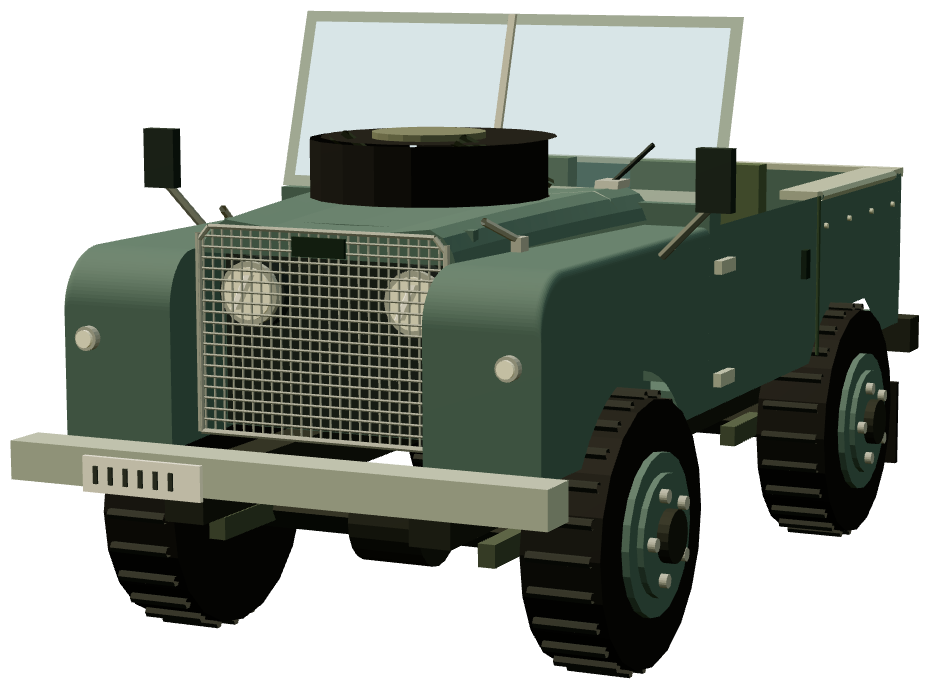
Variants
of this base modelFactory colours
pick one to repaint the rendersCodes on hover. Hex values are representative approximations of period paint unless a source states a measured value.
History
The Land Rover was conceived in 1947 by Rover's chief designer Maurice Wilks as a stop-gap to keep the Solihull works busy while post-war steel rationing throttled car production. Inspired by a war-surplus Jeep on his Anglesey farm, Wilks laid out a light four-wheel-drive workhorse on an 80-inch wheelbase, its body panels formed from Birmabright aluminium alloy - plentiful when steel was not - and its first colour famously taken from surplus aircraft-cockpit green paint. Launched at the Amsterdam Motor Show on 30 April 1948 with a 1.6-litre petrol four from the Rover P3 saloon and priced at £450, it was expected to sell perhaps 5,000 a year; roughly 8,000 were sold in the first full year and the 'stop-gap' rapidly outsold Rover's cars.
The 80-inch years were ones of constant refinement. The earliest vehicles drove all four wheels permanently through a freewheel in the front drive, replaced from 1950 by the selectable two/four-wheel-drive transfer box that became a Land Rover signature. For the 1952 season the 1,595 cc engine gave way to a torquier 1,997 cc four, the definitive Series I unit. Alongside the basic open utility, Solihull catalogued mobile welder, compressor and fire engine derivatives, while the coachbuilt seven-seat Station Wagon - bodied by Tickford and sold until 1951 - gave the marque its first passenger-carrying model, a rare and short-lived donor recorded separately in this registry. Abroad, the 80-inch was also assembled under licence, most notably by Minerva in Belgium, whose military variants likewise have their own registry records.
Period finishes were sparse: the pale grey-green known as Light or Pastel Green defined the launch era, joined by Rover's darker bronze greens, with the gloss military Deep Bronze Green standard on service vehicles; the other celebrated Series I colours, Dove Grey and RAF Blue, are documented only from around 1954 and 1957 respectively - after the 80-inch had left production. In 1954 the 80-inch chassis gave way to the 86-inch (and the new 107-inch pickup), beginning the growth that led to the definitive 88/109 dimensions. Total 80-inch production to 1953 came to about 82,395 vehicles including the Minervas, out of roughly 211,500 Series I Land Rovers of all wheelbases built by 1958. The first pre-production car, HUE 166, is preserved, and 80-inch vehicles - the purest expression of the original design - are today the most sought-after of all Series Land Rovers, sustained by Land Rover Classic's 'Reborn' restorations and a devoted club scene.
Imagery
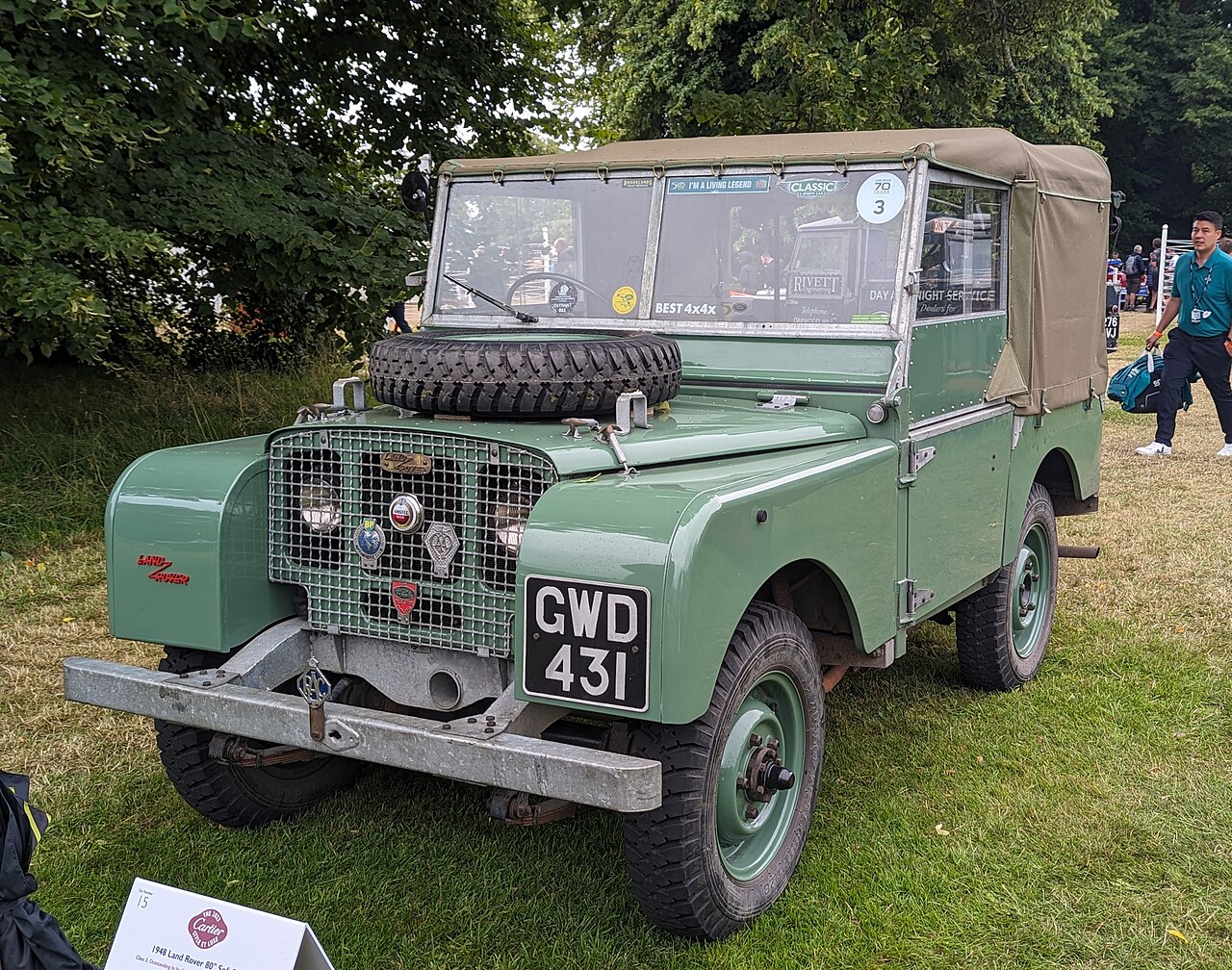

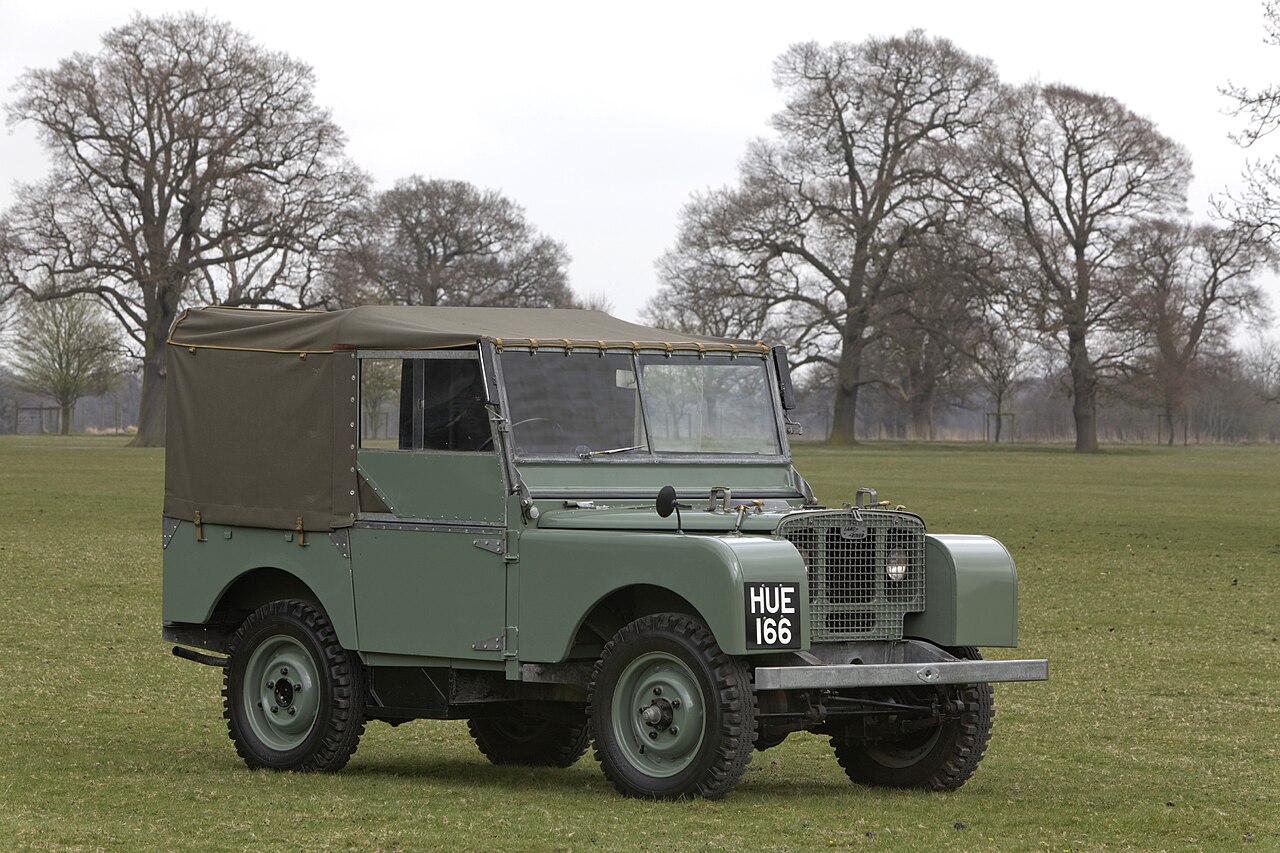
.jpg)
Registry record
- Manufacturer
- Rover Company (Solihull)
- Manufactured
- 1948–1953 (80″ wheelbase; Series I production ran 1948–1958)
- Engine type
- 1.6 L (1,595 cc) petrol inline-four; 2.0 L (1,997 cc) petrol inline-four from the 1952 season
- Production run
- ~82,395 80-inch vehicles 1948-53 (including Belgian Minerva licence production); ~211,500 Series I of all wheelbases 1948-58
- Country of origin
- United Kingdom
- Status
- out of production since 1953; the most collectable Series Land Rovers, with pre-production HUE 166 preserved
Catalogue data
- Record kind
- Base model
- Model line
- Series I
- Family
- Land Rover Series
- Series
- 1
- Wheels
- 4
- Nominal wheelbase
- 80″
- Body style
- No roof
- Variants
- 7
Base catalogue fields are exported from the Difflocked game. In-game physics values are arcade tuning, not certified historical measurements, and are deliberately not shown as specifications here.
Sources & citations
Researched sources
- Land-Rover 80" Series-I (1948-1953) (production 1948-1953; total 80-inch production 82,395 vehicles including Minervas; change from constant to selectable four-wheel drive; Station Wagon discontinued after 1951; welder, compressor and fire engine variants) ↗ — allisons.org (accessed 2026-09-10)
- A Quick History of the Land Rover Series 1 (Amsterdam debut 30 April 1948; 1.6-litre P3-derived engine; ~8,000 first-year sales; cockpit-green surplus paint; Light Green also known as Pastel Green) ↗ — Silodrome (accessed 2026-09-10)
- History of the Defender - One Life (30 April 1948 Amsterdam launch, 80in wheelbase, £450) ↗ — Land Rover UK (accessed 2026-09-10)
- Land-Rover 80 inch Model Changes - 1948 to 1953 (year-by-year development of the 80-inch model) ↗ — Land Rover Series One Club (accessed 2026-09-10)
- 1951 Land Rover Series I profile (Series I production 211,467 including prototypes; 2-litre engine for 1952) ↗ — Sports Car Market (accessed 2026-09-10)
- Land Rover Series 1 Dove Grey (Dove Grey documented circa 1954-1956 - after the 80-inch era) ↗ — Paintman Paint (accessed 2026-09-10)
- Land Rover FAQ: Series paint codes (Herberts Series I list; RAF Blue reported on 1957 models - after the 80-inch era) ↗ — Land Rover FAQ (lrfaq.org) (accessed 2026-09-10)
- Concours of Elegance hosts UK debut of Series I Reborn (five period finishes including Light Green and Bronze Green) ↗ — Concours of Elegance (accessed 2026-09-10)
Development reference notes
Series I front body review — series1-bronze and Series I configurations · HERITAGE-FLEET-REFERENCES.md
User photographs `s1.jpeg`, `imagesj.jpeg`, `25109914-1-55.jpg` and `s1_.jpeg` show the early Series I front: a narrow central wire-mesh radiator grille with inboard headlamps, broad flat-sided wings rolling over a long front radius, one small white sidelight per wing, and a bonnet tapering forward with rounded long side pressings. The shared Series I builder uses these proportions for both wheelbases. This is a visual reference interpretation, not a measured CAD scan.
Early Series I 80-inch and VIP B40 — rolls-royce-81 · HERITAGE-FLEET-REFERENCES.md
The 80-inch Series I is a selectable wheelbase, with corresponding shorter rear body and headlamps behind the wire grille. User references: `LBG.jpeg` and `images (16)gg.jpeg`. Available body configurations are included in the generated reference catalogue and supported by the workshop and model gallery. The VIP B40 inherits this complete early front and chassis, extending rear axle spacing by one inch to 81 inches. `ESU229-1.jpg`, `ESU229-2.jpg` and `b40.jpeg` show the raised painted rear quarter panels, curved transparent upper shields, framed door tops, raised passenger bench, tailgate fittings, step and ESU 229 plates. The top and rear remain open. Geometry uses copied base panels so future Series I front refinements carry through without another duplicate nose.
Series III front review — standard Series III configurations · HERITAGE-FLEET-REFERENCES.md
User references `hfhimages.jpeg`, `imagesl.jpeg`, and `IMG_1992-jpg.webp` show the tall tapered central plastic grille with shorter side vents, recessed radiator panel, broad wings with rounded leading edges, inboard wing headlamps and white sidelights above amber indicators. The standard Series III bonnet narrows toward the grille. Stage 1 V8 and Santana retain their distinct flush-front grilles. Meteor Works uses a **Series III front**, not the Series IIA front of the army and RAF Marshall ambulances. Its internal `marshal-series3` shell shares the Marshall coachwork but inherits Series III wings, bonnet, grille, headlamps and outer lamps. Meteor adds only its weathered livery, guard and emergency equipment around that standard front, avoiding duplicated headlamp pods. ### Coachwork front-panel corrections - Dobbo and the Marshall family (including Meteor Works and RAF rescue) retain clipped curved side skins through the front wings and doors at their custom body joins. - Queen Elizabeth II’s Series IIA station wagon uses the Series III-style wing-mounted headlights, bonnet and broad black grille shown in the supplied reference. No numberplate is modelled. Reference: `/Users/jo
Registry record updated 2026-09-09T20:23:59.013Z · status: researched