Forward Area Ambulance
An 88-inch Land Rover made to carry two stretchers by extending its floor out past the tailgate and stretching the canvas over longer hoops to cover the overhang — a short, nimble casualty carrier that could get further forward than the big 109-inch box ambulance. Catalogued by the Australian Army as census 6005A, 'Truck, Utility, 1/4 Ton, GS, With Stretcher Frame', it served in Vietnam and later with Reserve units at home.
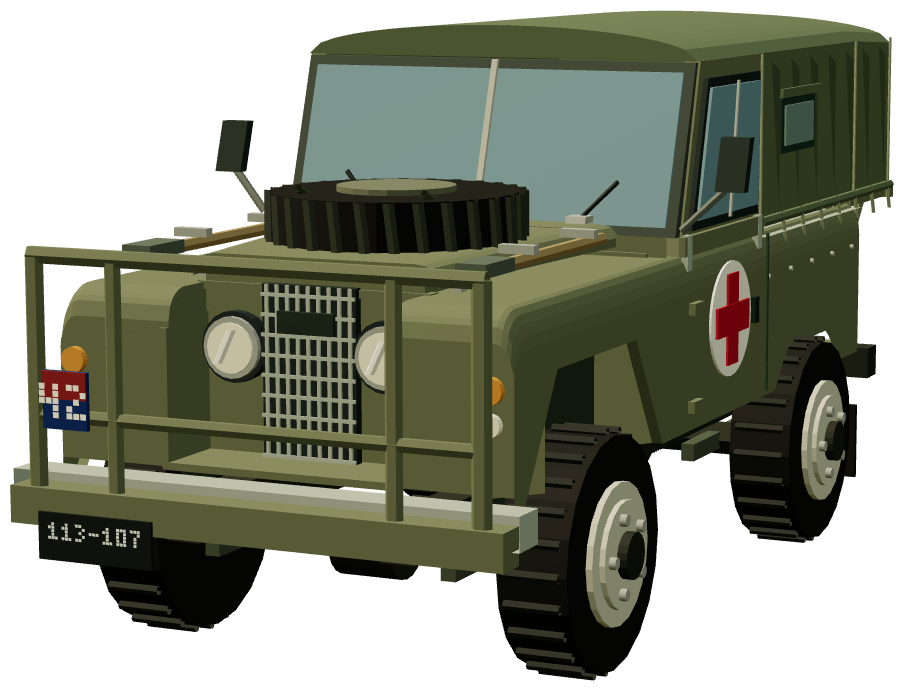
Factory colours
- Deep Bronze Green
- Australian Olive Drab (lustreless)
Codes on hover. Hex values are representative approximations of period paint unless a source states a measured value.
History
The Australian Army's standard Land Rover ambulance was a 109-inch vehicle with a purpose-built four-stretcher box body. Very few went to South Vietnam: they were large, comparatively unwieldy on tracks and in rubber plantations, and valuable enough that commanders preferred to hold them back from the fighting. The Forward Area Ambulance filled the gap that left. It took the short-wheelbase 88-inch Land Rover — the vehicle infantry units already had in numbers — and made it carry two stretchers laid over the top of the tub. Three changes did it: a floor extension projecting rearward beyond the tailgate to support the stretcher ends, a longer set of canopy hoops, and a longer canvas canopy to cover the overhang.
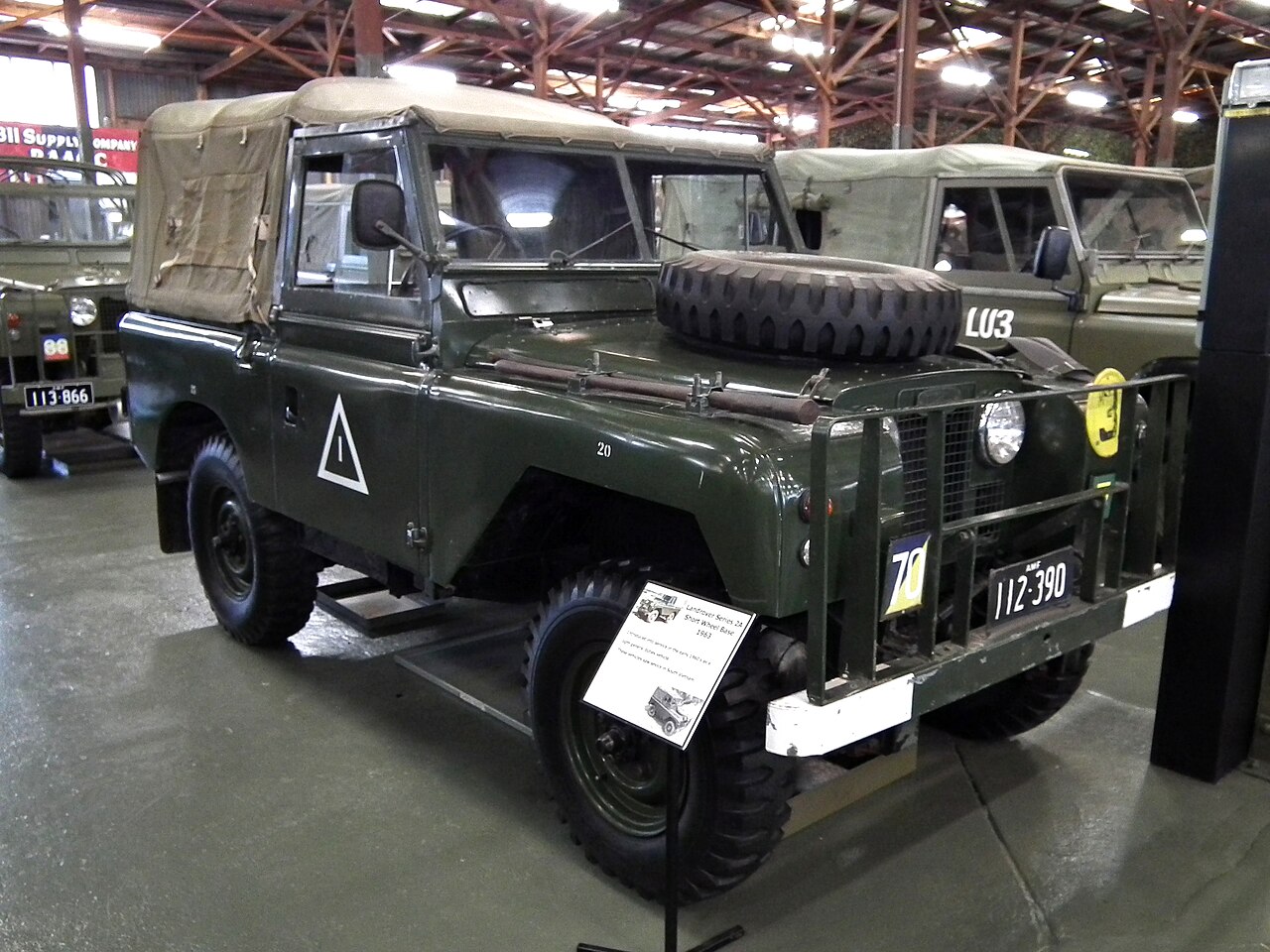
That canopy is the type's identifying feature and its best disguise. It is close enough in length to a 109-inch canopy to be mistaken for one, but the side window sits in the forward half rather than the middle, lining up with where it would fall on a normal short-wheelbase tilt. Surviving canopies have turned up in both the later vinyl material and earlier canvas. REMLR — which holds the only substantial published account of the type — reads the conversion as most likely a field or local-workshop modification rather than a factory or base-workshop programme, and states plainly that 'little is known of their history or numbers'.
What is documented is the register. REMLR lists 79 vehicles under census code 6005A, all 88-inch: 35 Series 2 and 44 Series 2A. The build dates fall in three blocks — 34 from 1959, 23 from 1963 and 21 from 1964 — matching the Australian Military Forces' Series 2 and early Series 2A contracts. Individual entries carry service annotations such as 'Fitted w/Stretcher frame', several marked for South Vietnam, and a number where the stretcher-frame note was later struck out or tippexed over, which suggests vehicles moved in and out of the role rather than being permanently converted. A related census code, 6005F, covers the same fitment on a winch-equipped 88.
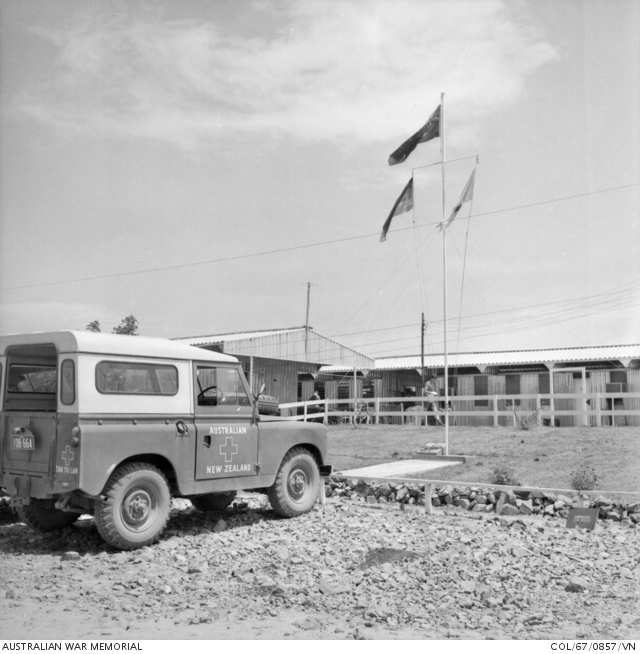
In Vietnam the FAAs appear in Australian War Memorial photography around airfields, alongside regimental aid posts and being unloaded from ships; one 1965 image identifies Gordon Boyd of Jannali, NSW, a bandsman and infantry platoon medic with D Company, 1RAR, beside his vehicle. Markings were the usual red cross on a white ground, sometimes painted over in the field, and at least one photograph shows a vehicle camouflaged with nothing more sophisticated than applied mud. The type also worked at home well after the war: a REMLR registrant recalls FAAs in use at the Infantry Centre, Singleton, in the late 1970s and early 1980s by Reserve units supporting cadet annual camps.
Colours followed Australian Military Forces practice rather than anything ambulance-specific. Vehicles delivered in 1959, 1963 and 1964 left the factory in gloss Deep Bronze Green, the fleet colour until April 1967; after that date the surviving fleet was resprayed in flat Australian Olive Drab, the colour chosen for Vietnam. Few survive in original condition. The best-documented restoration is Phillip Hastings's vehicle in Western Australia, photographed close to completion in 2010 and destined for the Nungarin Heritage Machinery and Army Museum. REMLR's page notes a Series 2 example illustrated in a Defence Materiel Organisation newsletter that may be the prototype, though that identification is not confirmed.
The registry's other Australian stretcher-carrying Land Rover, the 109-inch `series2a-fwsf`, is a different answer to a related problem — a full-size General Service cargo truck fitted with the box ambulance's stretcher rails. REMLR states that the timeframe of the FAAs, the FWSF trucks and the standard four-stretcher ambulances in relation to one another is unknown; they overlapped in service rather than replacing one another.
Imagery
.jpg)

Registry record
- Manufacturer
- Land Rover (Rover Company) — AMF-specification 88-inch Series II and Series IIA; stretcher body extension fitted in Australian service
- Manufactured
- Donor 88-inch vehicles of 1959 (34), 1963 (23) and 1964 (21); conversions in service through the Vietnam War and into the early 1980s
- Engine type
- 2.25 L petrol inline-four
- Production run
- 79 vehicles recorded by REMLR under census 6005A (35 Series 2, 44 Series 2A); no official total published
- Country of origin
- United Kingdom (vehicle) / Australia (conversion)
- Status
- withdrawn; few survive in original configuration, one restored example associated with the Nungarin Heritage Machinery and Army Museum, WA
Catalogue data
- Record kind
- Named model
- Model line
- Series II
- Wheels
- 4
- Nominal wheelbase
- 88″
Base catalogue fields are exported from the Difflocked game. In-game physics values are arcade tuning, not certified historical measurements, and are deliberately not shown as specifications here.
Sources & citations
Researched sources
- Forward Area Ambulance (conversion description, canopy identification, likely field modification, Vietnam and Singleton service, full ARN register of 79 vehicles, Phillip Hastings restoration) ↗ — Registry of Ex-Military Land Rovers (REMLR) (accessed 2026-09-10)
- Census Codes and ARN Notes for Land Rovers (6005A and 6005F nomenclature; contrast with 6028D/6028E and the 6362B four-stretcher ambulance) ↗ — Registry of Ex-Military Land Rovers (REMLR) (accessed 2026-09-10)
- Australian Army Vehicle Colour Schemes and Paint (Deep Bronze Green gloss on Series 2 and pre-April-1967 Series 2A; Australian Olive Drab from April 1967) ↗ — Registry of Ex-Military Land Rovers (REMLR) (accessed 2026-09-10)
- Red Cross Land Rover in front of the 8th Field Ambulance Hospital, Vung Tau, September 1967 (AWM collection item C36955) ↗ — Australian War Memorial (accessed 2026-09-10)
Catalogue references
- https://www.remlr.com/2afaa.php https://www.remlr.com/2afaa.php ↗
Development reference notes
101 Forward Control ambulance · MILITARY-MODEL-REFERENCES.md
- [Production ambulance photographed by Steve Glover, 1981 vehicle](https://commons.wikimedia.org/wiki/File:Land_Rover_101_Forward_Control_Ambulance_(1981).jpg): split raked screen, separate medical body, projecting roof brow, twin corner vents, low headlamps, central grille, steps and rear doors. - [Dunsfold Collection's prototype ambulance](https://dunsfoldcollection.co.uk/collection/101-forward-control-ambulance/): useful side/body reference; its large overhead grille differs from the production front used here. - [Factory 101 manual](https://www.landroverweb.com/Pdf-files/Manuals/Land_Rover_101_Forward_Control_Manual.pdf): 101-inch chassis. Model and physics use 2.5654 m axle spacing.
[Production ambulance photographed by Steve Glover, 1981 vehicle](https://commons.wikimedia.org/wiki/File:Land_Rover_101_Forward_Control_Ambulance_(1981).jpg): split raked screen, separate medical body, projecting roof brow, twin corner vents, low headlamps, central grille, steps and rear doors. · MILITARY-MODEL-REFERENCES.md
- [Production ambulance photographed by Steve Glover, 1981 vehicle](https://commons.wikimedia.org/wiki/File:Land_Rover_101_Forward_Control_Ambulance_(1981).jpg): split raked screen, separate medical body, projecting roof brow, twin corner vents, low headlamps, central grille, steps and rear doors.
[Dunsfold Collection's prototype ambulance](https://dunsfoldcollection.co.uk/collection/101-forward-control-ambulance/): useful side/body reference; its large overhead grille differs from the production front used here. · MILITARY-MODEL-REFERENCES.md
- [Dunsfold Collection's prototype ambulance](https://dunsfoldcollection.co.uk/collection/101-forward-control-ambulance/): useful side/body reference; its large overhead grille differs from the production front used here.
101 Forward Control ambulance · MILITARY-REFERENCES.md
- 101 Forward Control ambulance: https://dunsfoldcollection.co.uk/collection/101-forward-control-ambulance/ — cab-over layout, overhead ventilation grille; rear photo RGN239P-2.jpg used for door windows and medical panel.
Drive it
This vehicle is playable in the Difflocked racing game.
RACE THE FORWARD AREA AMBULANCE ↗Registry record updated 2026-09-10T03:45:29.347Z · status: researched