Mine Protected Land Rover
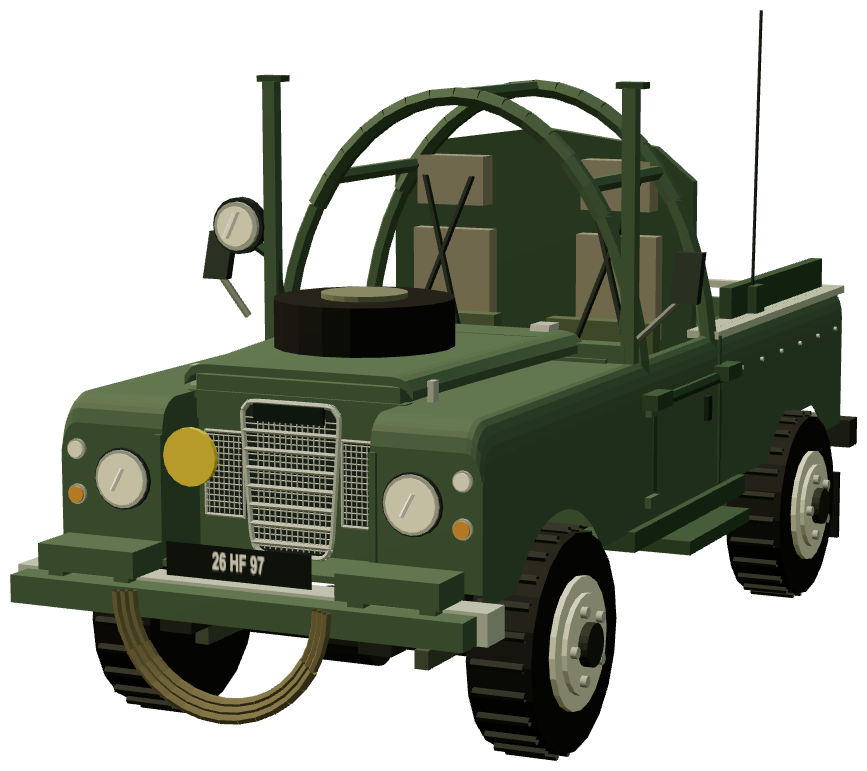
A mine-protected conversion of the Series III 109 Land Rover, with hooped roll bars and deflective belly armour, of the pattern Britain supplied to the Commonwealth Monitoring Force for the Rhodesia-Zimbabwe ceasefire and 1980 elections (Operation Agila). The identification rests on this record's reference advert - a restored example from the late Gordon Beale's collection - and the converting workshop is unconfirmed, so the record is held at draft.
Factory colours
- Olive Drab
Codes on hover. Hex values are representative approximations of period paint unless a source states a measured value.
History
British forces had experimented with mine protection for Land Rovers since the counter-insurgency campaigns in Aden and the peacekeeping commitment in Cyprus, where patrol vehicles faced buried anti-personnel mines. The resulting conversion kept the standard Series III 109 running gear but added deflective armour plate under the chassis, protective plating around the fuel tanks beneath the front seats, deflection plates along the sills and dashboard top, vertical armour behind the seats, and prominent hooped roll-over bars above an open body, so that a mine blast would be shed outwards and the crew retained in a survivable space.
The type is best known from Operation Agila, the Commonwealth Monitoring Force deployment that supervised the Lancaster House ceasefire in Rhodesia and the elections that created Zimbabwe, between December 1979 and March 1980. Britain provided around 80 vehicles for the roughly 1,500-strong force drawn from the United Kingdom, Australia, New Zealand, Kenya and Fiji, and the mine-protected Land Rovers were marked with a large white cross to signal the force's impartiality to all factions during the ceasefire and election period.
Rhodesian engineers, who had far harder experience of anti-tank mines and had evolved their own purpose-built monocoque designs - the Rhino and Kudu conversions and the extraordinary Pookie detector vehicle - regarded the British Aden/Cyprus pattern as inadequate against the heavier mines common in the bush war. In the event the monitoring force's deployment passed without the vehicles being put to that test.
Surviving examples are rare. The vehicle referenced by this record was advertised on Milweb on behalf of the family of the late collector Gordon Beale, described as extensively restored with excellent mechanicals and a full in-service history, its first service having been the peacekeeping duties around Zimbabwe's 1980 elections.
Registry record
- Manufacturer
- Land Rover (British Leyland)
- Manufactured
- Series III 109 donors; conversions late 1970s
- Modifier / coachbuilder
- British military conversion (converting workshop unconfirmed)
- Engine type
- 2.25 L petrol inline-four (standard Series III 109)
- Production run
- ~80 vehicles supplied to the Commonwealth Monitoring Force
- Country of origin
- United Kingdom
- Status
- retired; occasional restored examples in private collections
Catalogue data
- Record kind
- Named model
- Model line
- Series III
- Wheels
- 4
Base catalogue fields are exported from the Difflocked game. In-game physics values are arcade tuning, not certified historical measurements, and are deliberately not shown as specifications here.
Sources & citations
Researched sources
- Mine Protected Land Rover (sale advert for the late Gordon Beale's restored example) ↗ — Milweb (accessed 2026-09-09)
- Mine Protected Land Rover Query (Aden/Cyprus origins; ~80 vehicles for the Commonwealth Monitoring Force; white cross marking; Rhodesian criticisms) ↗ — KitMaker Network forums (accessed 2026-09-09)
- Rhodesian Mine Protected LR (conversion details: roll hoops, belly plates, fuel-tank armour, sill deflection plates; white cross; army green finish) ↗ — East Neuk Model Club (accessed 2026-09-09)
- Commonwealth Monitoring Force (Operation Agila, December 1979 - March 1980) ↗ — Wikipedia (accessed 2026-09-09)
Catalogue references
- https://www.milweb.net/webvert/a5594/101026 https://www.milweb.net/webvert/a5594/101026 ↗
Drive it
This vehicle is playable in the Difflocked racing game.
RACE THE MINE PROTECTED LAND ROVER ↗Registry record updated 2026-09-09T10:08:23.613Z · status: draft