Perentie 6×6 Ambulance
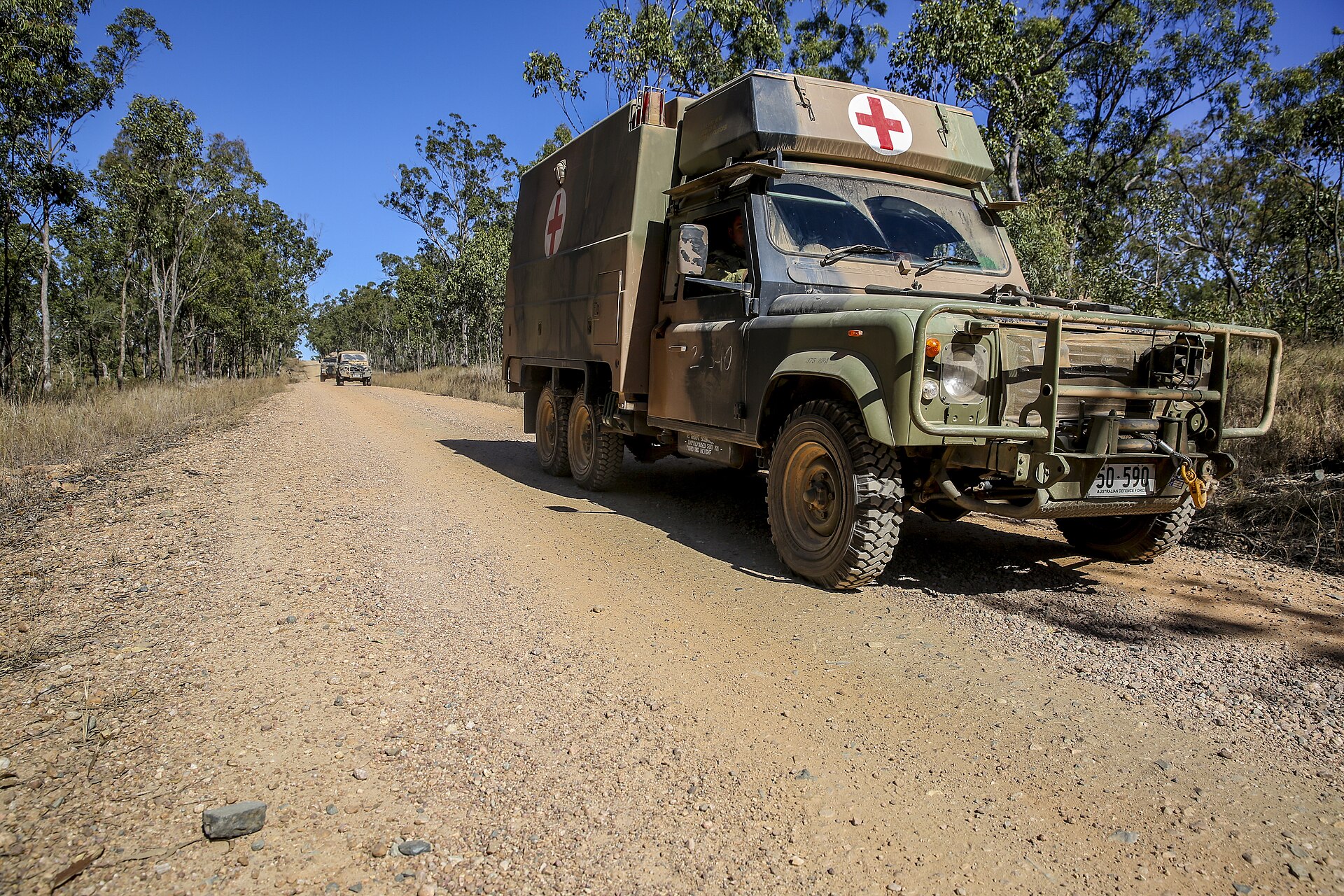
'Truck, Ambulance, Light, 4 Litter, FFR, Winch, MC2' — the Australian Army's front-line field ambulance from 1989, a Perentie 6×6 carrying a self-contained, demountable fibreglass treatment module for four stretcher cases or eight seated casualties plus two medics. Ninety-four were built, and they took over the Army's overseas casualty-evacuation work from the ageing Series IIA ambulances.
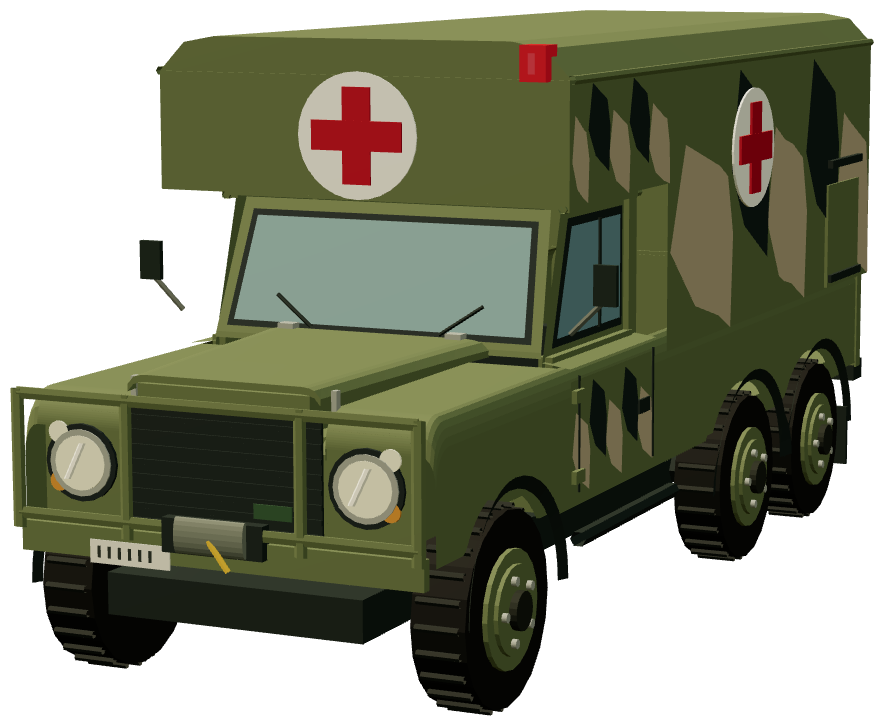
Factory colours
- Australian Olive Drab (lustreless)
- Auscam Camouflage Tan (Brown)
- Auscam Camouflage Black
- Ambulance White
Codes on hover. Hex values are representative approximations of period paint unless a source states a measured value.
History
The ambulance is the most specialised of the three fully enclosed Perentie 6×6 bodies, and the only one built purely to carry people rather than equipment. Its liability code, 74505, spells out the specification in Army shorthand: light truck, four litters, fitted for radio, winch, MC2. The stated role is to transport up to eleven personnel including the driver — four stretcher (litter) patients or eight seated casualties, plus two medical assistants — with seatbelts provided at every position and three seats in the cab.
The treatment module is the point of the vehicle. It is a fibreglass box mounted to the chassis on exactly the same points as the cargo tray body, and apart from some hoses and wiring it is entirely self-contained: it can be lifted off and put back on without touching the running vehicle. Inside, a 24-volt system feeds the radios, the interior lighting and the medical equipment while the Land Rover beneath it stays on 12 volts. REMLR records a detail worth knowing for anyone matching parts: the modules fitted to the Army's Mitsubishi Canter ambulances look the same, but their mounting arrangements are completely different and the two are not interchangeable.
Wikipedia's Perentie variant table gives 94 ambulances built, against REMLR's ARN register, which lists 88 vehicles under the full nomenclature — a modest and typical discrepancy between the published figure and the surviving registration ledgers. Either way it is a small class: roughly one in seven of the 699 6×6s, and about the same size as the air defence batch.
The ambulances arrived just as the Army's Land Rover medical fleet was changing hands. The old 109-inch four-stretcher Series 2A box ambulances had been the standard for two decades; REMLR's account of United Nations deployments notes that some were painted overall white and put in storage ready to go, only for the Land Rover 6×6 ambulances to replace them before the deployment happened. Where earlier Australian casualty carriers had been improvisations on general-purpose chassis — the 88-inch Forward Area Ambulance with its extended canopy, or the 109-inch trucks 'fitted with stretcher frame' — the Perentie ambulance was designed as an ambulance from the chassis rails up, with a purpose-built body, its own power, and the ground clearance and payload of a three-axle truck.
Colour followed the fleet: lustreless Australian Olive Drab from the Moorebank line, repainted into the three-colour Auscam disruptive pattern of olive drab, tan and black through the 1990s, and overall white with black UN lettering for United Nations service. The vehicles served through Timor-Leste, the Solomon Islands and later deployments, and remained visible on exercise well into the 2010s. Like the rest of the fleet they lacked mine and IED protection, and were replaced under Project Land 121 by the Mercedes-Benz G-Wagon — including a 6×6 ambulance variant — with disposals from around 2012.
Mechanically the vehicle is the standard Perentie 6×6: JRA Limited's widened, hot-dip galvanised chassis with twin rear axles, permanent four-wheel drive with selectable six-wheel drive, helicopter sling and recovery points, and the turbocharged Isuzu 4BD1-T 3.9-litre diesel, built at Moorebank until the plant closed on 30 September 1992.
Imagery

Registry record
- Manufacturer
- JRA Limited (Jaguar Rover Australia), Moorebank, NSW — under Land Rover licence
- Manufactured
- 1989–1992 (6×6 deliveries from March 1989; Moorebank closed 30 September 1992)
- Engine type
- Isuzu 4BD1-T 3.9 L turbocharged diesel inline-four
- Production run
- 94 vehicles (Wikipedia's Perentie variant table); REMLR's ARN register lists 88
- Country of origin
- Australia
- Status
- retired from ADF service (replaced under Project Land 121 by the Mercedes-Benz G-Wagon, including a 6×6 ambulance variant; disposals from c. 2012)
Catalogue data
- Record kind
- Named model
- Family
- Perentie 6×6
- Body style
- ambulance
- Wheels
- 6
- Roof
- ambulance
Base catalogue fields are exported from the Difflocked game. In-game physics values are arcade tuning, not certified historical measurements, and are deliberately not shown as specifications here.
Sources & citations
Researched sources
- Perentie 6x6 Ambulance — nomenclature and liability code 74505, eleven personnel including driver, four litters or eight seated plus a medical assistant, demountable self-contained module, 24 V/12 V split, incompatibility with the Mitsubishi Canter module ↗ — Registry of Ex-Military Land Rovers (REMLR) (accessed 2026-09-10)
- Land Rover 110 — 6x6 Ambulance ARN register (88 vehicles listed under 'Truck, Ambulance, Light, 4 Litter, FFR, Winch, MC2') ↗ — Registry of Ex-Military Land Rovers (REMLR) (accessed 2026-09-10)
- Land Rover Perentie — variant table quoting 'Truck, Ambulance, 4 Litter, FFR, Winch, MC2 (94 Vehicles)' ↗ — Wikipedia (accessed 2026-09-10)
- Australian Army Vehicle Colour Schemes and Paint — olive drab to Auscam changeover; overall white with UN lettering for United Nations service, and the note that Land Rover 6×6 ambulances replaced the Series 2a ambulances held ready for deployment ↗ — Registry of Ex-Military Land Rovers (REMLR) (accessed 2026-09-10)
- Ex-military Land Rover 110 Perentie 6x6 — the ambulance as one of three 6×6 variants with fully enclosed fibreglass rear bodies; module dimensions and 2007–08 replacement bodies ↗ — 4X4 Australia (accessed 2026-09-10)
Drive it
This vehicle is playable in the Difflocked racing game.
RACE THE PERENTIE 6×6 AMBULANCE ↗Registry record updated 2026-09-10T03:45:29.712Z · status: researched