Project HEBE
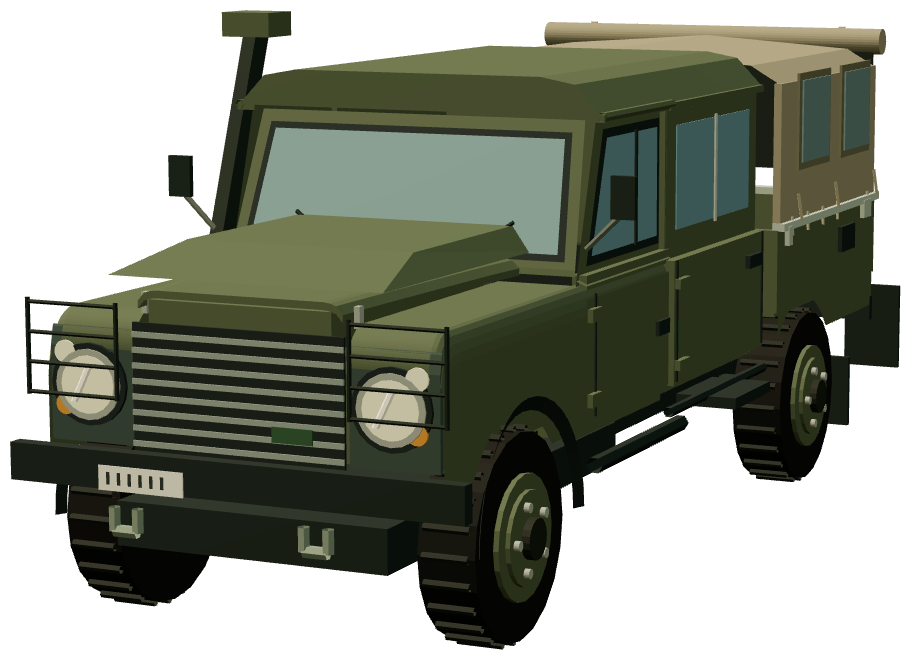
Project HEBE was a British Ministry of Defence programme, begun in 2009-10, to convert surplus Land Rover Defender 130 'Pulse' battlefield ambulances into four-man high-capacity double-cab pick-up trucks. Up to 500 conversions were originally mooted; a 2021 Freedom of Information response confirmed that 168 were actually completed by the Defence Support Group.
Factory colours
- NATO Green (IRR)
- Camouflage Desert Sand
Codes on hover. Hex values are representative approximations of period paint unless a source states a measured value.
History
The donor vehicle was the Defender 130 Battlefield Ambulance, built under Land Rover's Project PULSE and ordered in January 1996 alongside the roughly 8,000 Wolf 90 and Wolf 110 Truck Utility Light and Medium vehicles. Around 800 Pulse ambulances were built (a Ministry of Defence FOI list names 816 individual vehicles), with a four-stretcher hard-sided body on the 130-inch chassis and the 2.5-litre 300Tdi turbo-diesel. They were procured at a time when planners assumed that opponents would either respect Red Cross markings or be irregulars without the means to exploit a soft-skinned ambulance; the Iraq and Afghanistan campaigns overturned that assumption, and although armoured battlefield ambulances were bought, they never came in numbers sufficient to replace the Pulse fleet outright, leaving a pool of surplus soft-skin ambulance bodies.
By the end of the 2000s the Defence Support Group — formed in 2008 from the Army Base Repair Organisation and the Defence Aviation Repair Agency — was looking for work to keep its largely civilian workshop staff occupied, and Project HEBE (named after the Greek goddess of youth) was one of several resulting study projects. The scheme replaced the ambulance body hamper with an off-the-shelf pick-up cargo bed, added a new glassfibre high-line cab roof and fitted the internal roll-over protection system originally developed for the Wolf fleet under Project REMUS, producing a double cab seating four with an 800 kg payload. Most of the parts were either standard stock items or salvaged from donor vehicles. The Ministry of Defence named Mortar Section Vehicle — presumably for 3 Commando and 16 Air Assault Brigades, whose long-wheelbase Land Rovers and Pinzgauers offered only two forward-facing seats — and Convoy Escort Vehicle as the intended roles.
Three prototypes are recorded (registrations HE88AA, LA77AA and LB49AA); one, LV77AA in Bob Morrison's account of the DVD 2010 display, had entered service as an ambulance on 28 January 1998 and was re-designated on the MoD list from 'AMBULANCE 4X4 4 STRETCHER HS' to 'TRUCK UTY MED (HS) 4X4 GS HARD TOP LAND ROVER 130 2.5 LTR TURBO DSL DOUBLE CAB PICK UP'. In autumn 2011 DSC Colchester delivered six further conversions to the British Army Training Liaison Staff Kenya (KY57AA, KZ53AA, KZ66AA, LA40AA, LA74AA and LA96AA); these were built with padded custom soft tops rather than the hard top, and left the workshops painted white. A further identified batch of thirteen carried RZ**AB registrations and appear on MoD listings simply as 'Defender 130 DOUBLE CAB'. The total remained obscure until the 2021 FOI answer from Army Policy & Secretariat at Andover confirmed 168 conversions, far short of the 500 once discussed but far more than the couple of dozen observers had assumed.
Registry record
- Manufacturer
- Land Rover (Defender 130 chassis; donor bodies built under Project PULSE)
- Manufactured
- 1996-98 donor ambulances; conversions from 2010
- Modifier / coachbuilder
- Defence Support Group (DSG), DSC Colchester workshops
- Engine type
- 2.5 L 300Tdi turbo-diesel inline-four
- Production run
- 168 conversions completed (2021 MoD FOI response); up to 500 originally proposed
- Country of origin
- United Kingdom
- Status
- in British Army service; converted vehicles used mainly as mortar section and utility trucks
Catalogue data
- Record kind
- Named model
- Model line
- Defender
- Wheels
- 4
Base catalogue fields are exported from the Difflocked game. In-game physics values are arcade tuning, not certified historical measurements, and are deliberately not shown as specifications here.
Sources & citations
Researched sources
- MLR49 Project HEBE ~ Ambulances To Pick-Up Trucks (Bob Morrison) ↗ — Joint Forces News (accessed 2026-09-10)
- MLR Pt.12 - Pulse 130 Battle Field Ambulance (Bob Morrison) ↗ — Joint Forces News (accessed 2026-09-10)
Catalogue references
- https://www.joint-forces.com/utility-4x4/44516-mlr49-project-hebe-ambulances-to-pick-up-trucks https://www.joint-forces.com/utility-4x4/44516-mlr49-project-hebe-ambulances-to-pick-up-trucks ↗
Drive it
This vehicle is playable in the Difflocked racing game.
RACE THE PROJECT HEBE ↗Registry record updated 2026-09-10T02:08:52.134Z · status: researched