Shorland Mk 3 APC · UDR
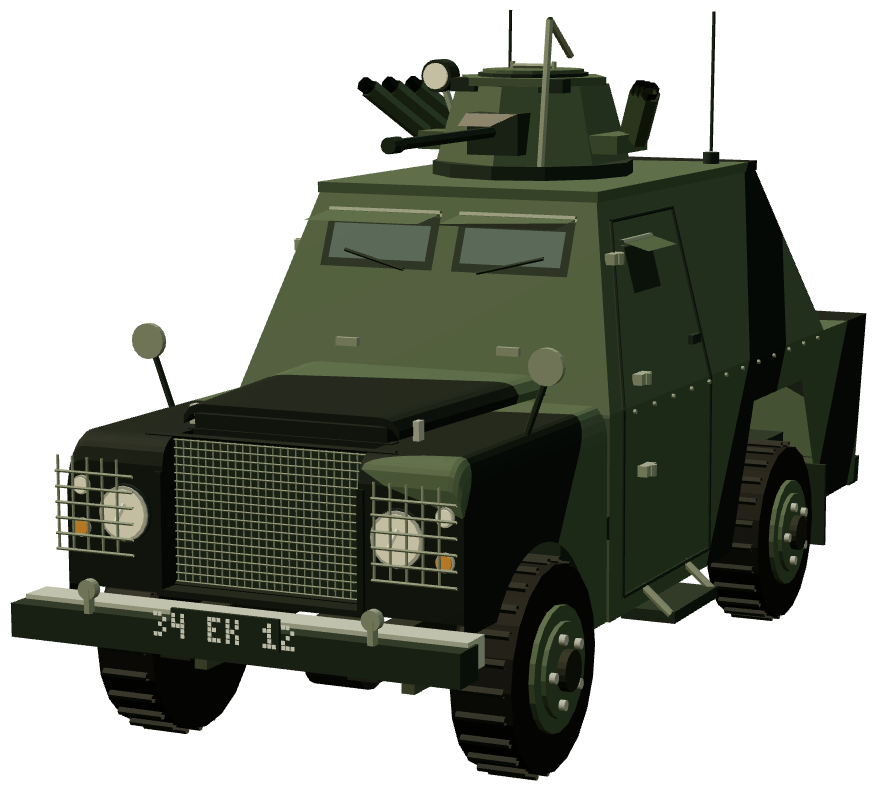
The Ulster Defence Regiment's Mark 3 Shorland: the same 2,625 cc six-cylinder turreted patrol car as the Dutch cars, but delivered new from 1972 in olive drab on xxFLxx and xxGFxx military registrations, with turret-mounted triple smoke dischargers and an angle-iron wire cutter welded above the turret.
Factory colours
- Olive Drab
- Deep Bronze Green
Codes on hover. Hex values are representative approximations of period paint unless a source states a measured value.
History
The Ulster Defence Regiment was raised on 1 April 1970, and armoured Shorlands reached it by two routes. The first was inheritance: after the Army's deployment on Operation BANNER it was decided to take turreted armoured vehicles away from the Royal Ulster Constabulary, and the surviving ex-RUC Mark 1s were requisitioned, repainted from satin emerald green into high-gloss deep bronze green with matt black disruptive stripes, and reissued on military xxBTxx registrations. Those cars were removed from service in 1977. The second route, and the one this record covers, was new-build: from 1972 the UDR received Mark 3 Shorlands direct from Short Brothers & Harland in Belfast.
The new cars differed from the ex-police ones in more than age. The Shorland Site records that they were originally painted olive drab and allocated xxFLxx and xxGFxx registrations — the marks issued against a normal wheeled-vehicle contract, unlike the xxBTxx series used for transfers. They were fitted as delivered with a pair of turret-mounted triple smoke dischargers, an option that had always been on Shorts' list but had never been specified on RUC cars. Mechanically they were standard Mark 3s: a Series III 109-inch chassis, the Rover 2,625 cc six-cylinder petrol engine giving 91 bhp at 4,100 rpm, and an unladen weight of 2,941 kg. For a period the new Mark 3s and the requisitioned Mark 1s served side by side.
In Northern Ireland service the Shorland's job was less shooting than presence. The Shorland Site's photograph of a rural vehicle check point shows the pattern: a UDR soldier questioning a civilian driver, a colleague under cover behind an Army Series III, and the Shorland dominating the far side of the road to give the check point authority. A local field modification is the clearest UDR recognition feature — an angle-iron wire cutter welded to the turret to deflect or sever wire strung across roads at neck height to decapitate a gunner standing in the hatch. Because most Mark 3 Shorlands that collectors encounter are ex-UDR vehicles built from 1972, the mark is widely and wrongly assumed always to sit on a Series III chassis; the Shorland Site is explicit that early Mark 3s used late Series IIA chassis.
The turret was also the vehicle's political liability. In civil-disorder situations it caused the Shorland to be reported as a tank, and a number of cars had their turrets removed and the roof plated over; some of the removed turrets were transplanted onto Humber 'Pig' armoured trucks, which gained an observation position at the cost of considerable extra weight. Withdrawal came in the 1980s: the Shorland Site's FAQ records around 90 ex-British Army Mark 3 Shorlands coming onto the market in the late 1980s, and photographs show batches of ex-UDR cars in dealers' yards in 1987. Several turretless survivors were refurbished for use by television news crews in Bosnia, the absent turret being an advantage in signalling non-combatant status; one is preserved awaiting restoration at The Tank Museum, Bovington, and a restored ex-UDR car remains in Northern Ireland. The UDR itself was amalgamated into the Royal Irish Regiment in 1992.
Registry record
- Manufacturer
- Short Brothers ↗& Harland Ltd, Belfast (Short Brothers from 1977)
- Manufactured
- UDR deliveries from 1972; Mk 3 production ran until the Mk 4 replaced it in 1980
- Modifier / coachbuilder
- Short Brothers ↗Shorland armoured vehicle division
- Engine type
- Rover 2,625 cc six-cylinder petrol, 91 bhp at 4,100 rpm
- Production run
- 500+ Mk 3s built in all; ~90 ex-British Army Mk 3s released onto the market in the late 1980s
- Country of origin
- United Kingdom (Northern Ireland)
- Status
- withdrawn from service in the 1980s; examples preserved, including at The Tank Museum, Bovington
Catalogue data
- Record kind
- Named model
- Model line
- Series III
- Wheels
- 4
- Nominal wheelbase
- 109″
Base catalogue fields are exported from the Difflocked game. In-game physics values are arcade tuning, not certified historical measurements, and are deliberately not shown as specifications here.
Sources & citations
Researched sources
- Shorland Mark 3 APC ↗ — The Shorland Site (accessed 2026-09-10)
- The History of Shorland Armoured Cars ↗ — The Shorland Site (accessed 2026-09-10)
- Shorland FAQ ↗ — The Shorland Site (accessed 2026-09-10)
- MLR26 — Short Brothers APV and Otokar ZPT ↗ — Joint Forces News (Bob Morrison) (accessed 2026-09-10)
- Shorland armoured car ↗ — Wikipedia (accessed 2026-09-10)
- Shorland Armoured Patrol Vehicle ↗ — Gun Mart (accessed 2026-09-10)
Catalogue references
- https://shorlandsite.com/shorland-mark-3-apc/ https://shorlandsite.com/shorland-mark-3-apc/ ↗
Drive it
This vehicle is playable in the Difflocked racing game.
RACE THE SHORLAND MK 3 APC · UDR ↗Registry record updated 2026-09-10T08:09:13.552Z · status: researched