Shorland S52 APC
The definitive Series 5 armoured patrol car: an S51 lengthened behind the crew compartment so that the extended rear cabin could carry weapons, ammunition and radios, reached through a large rear hatch instead of the S51's cramped escape door. Once the S51 was dropped the S52 became the Shorland patrol car, and it was also the platform for the S53 air-defence vehicle.
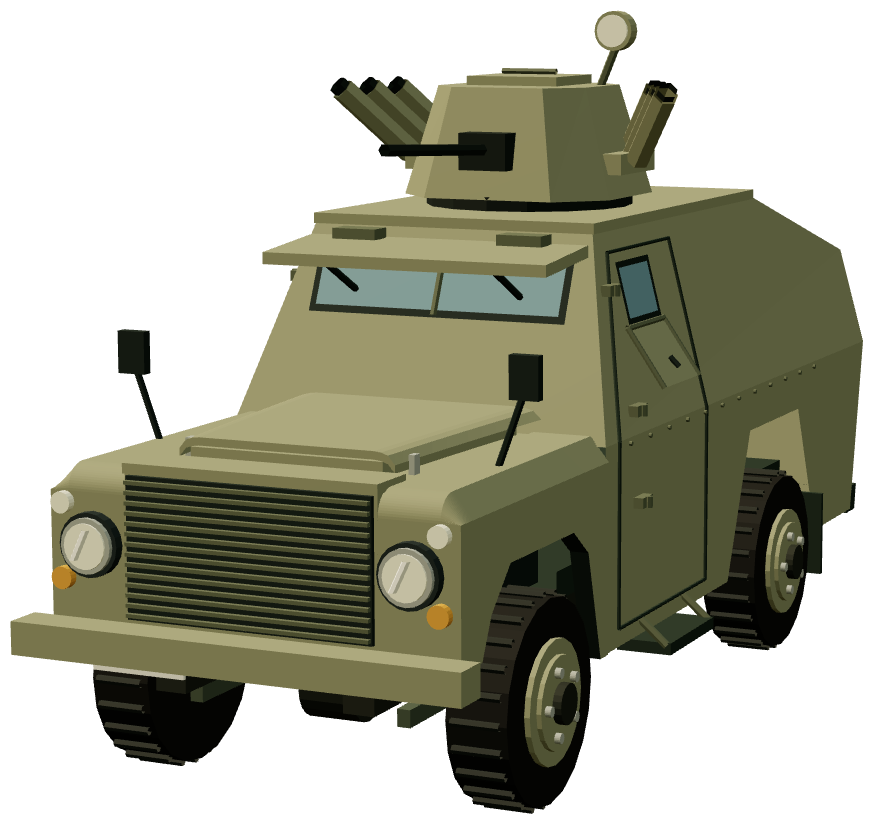
History
The S52 began as a lightly promoted alternative to the S51, sharing its specification exactly but for one change: the rear cabin was extended well beyond the S51's short sloping boot. The extra volume was intended for the stowage of arms and ammunition rather than for additional crew, and instead of the S51's small escape hatch the rear panel carried a large hatch that made both bailing out and loading bulky equipment far easier. Operators clearly preferred the arrangement — Shorts withdrew the S51 and promoted the S52 as the Shorland Armoured Patrol Car, the role it filled for the rest of the line's life.
Underneath, the S52 is the standard Series 5: the 110 in heavy-duty Land Rover Defender chassis with permanent four-wheel drive and a lockable centre differential, strengthened to carry the armoured body and given stronger axles, uprated suspension and revised final drive ratios, yet still about 85 per cent stock Land Rover parts. The normal engine was the 3.5-litre Rover V8 petrol, with the 2.5-litre Rover turbo-diesel available. The all-welded hull stopped NATO 7.62 x 51 mm ball fired at right angles down to 25 m, the bullet-resistant glazing met BS 5051 Part 1 Class R2 to the same standard as the steel, the engine and radiator were fully armoured and the floor was reinforced glass fibre against mines and improvised devices. Fuel fillers sat under armoured hatches releasable from inside. Air conditioning and seat belts were standard; run-flat tyres, drop-down vision-block visors in place of the windscreen, a loudhailer, automatic fire protection, smoke dischargers and left- or right-hand steering were options.
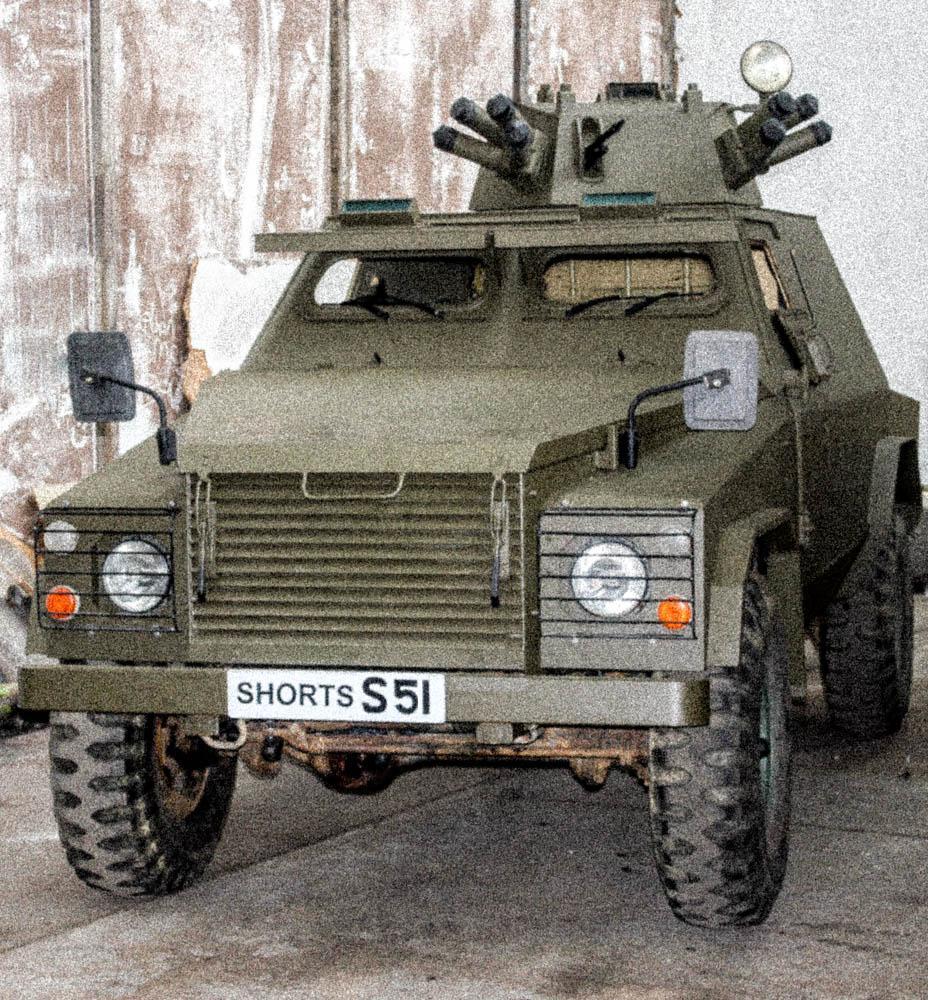
The manually operated turret traversed a full 360 degrees on an adjustable gunner's seat, with a mechanical lock, an optical periscope sight boresighted to the armament and a linked searchlight. The usual weapon was the FN Herstal 7.62 mm GPMG with about 1,600 rounds carried, though most light machine guns could be fitted, and a four-barrelled 66 mm grenade launcher could be mounted on each side of the turret for smoke, illumination or CS. For observation the turret could be opened out, its rear part folding forwards and upwards while the turret back folded down. Two extractor fans were fitted, one on the sloping rear roof and one in the turret for fume extraction when firing. Sources disagree on the crew: the Army Guide description gives three — driver, commander and turret gunner, with an alternative gunner's seat behind the commander — while the same page's specification table states four. Quoted dimensions are 4,490 mm long, 1,800 mm wide and 1,800 mm high on a 2,795 mm wheelbase, with 324 mm ground clearance, a 136-litre tank, 630 km road range, 500 mm fording and a 6.6 m turning radius at 3,600 kg.
Published user figures need care. Army Guide's Shorland patrol-car entry, headed S52 but written to cover the whole patrol-car line back to 1965, lists 255 vehicles across sixteen countries: Syria 100, Malaysia 40, Thailand 32, Botswana 10, Mali 9, Bahrain 8, Kenya 8, Lesotho 8, Burundi 7, Argentina 5, Cyprus 5, Libya 5, Portugal 5, the United Arab Emirates 5, the United Kingdom 5 and Guyana 3. Those totals cannot be attributed to the S52 alone, and Wikipedia's SIPRI-derived operator list gives materially different numbers for several of the same countries (Argentina 20, Libya 15, Syria 4, and additional users including Saudi Arabia and Venezuela), so the two sets should be treated as conflicting rather than complementary. Late in 1996 Shorts sold the complete Shorland line, and the S600, to British Aerospace Australia; early in 1999 Tenix Defence Systems acquired that vehicle business, and no Shorland S52 or its variants had been built in Australia at that point.
Imagery

Registry record
- Manufacturer
- Short Brothers ↗
- Manufactured
- Series 5 generation, late 1980s to 1996 (Shorland line sold to British Aerospace Australia late 1996; no Series 5 production undertaken in Australia)
- Modifier / coachbuilder
- Short Brothers ↗Shorland armoured vehicle line, Belfast
- Engine type
- 3.5-litre Rover V8 petrol (134 hp); 2.5-litre Rover turbo-diesel optional
- Production run
- 255 Shorland patrol cars across 16 countries per Army Guide's Jane's-derived entry — a figure covering the whole patrol-car line, not the S52 alone; Wikipedia's SIPRI-derived operator list gives conflicting per-country numbers
- Country of origin
- United Kingdom (Belfast, Northern Ireland)
- Status
- out of production
Catalogue data
- Record kind
- Named model
- Model line
- Defender
- Wheels
- 4
- Nominal wheelbase
- 110″
Base catalogue fields are exported from the Difflocked game. In-game physics values are arcade tuning, not certified historical measurements, and are deliberately not shown as specifications here.
Sources & citations
Researched sources
- Shorland Series 5 APC ↗ — The Shorland Site (accessed 2026-09-10)
- Shorland S52 (Reconnaissance Vehicle) ↗ — Army Guide (Jane's-derived) (accessed 2026-09-10)
- Shorland armoured car — operators and Series 5 variants ↗ — Wikipedia (accessed 2026-09-10)
- Shorland Armoured Patrol Vehicle ↗ — Gun Mart (accessed 2026-09-10)
Catalogue references
- https://shorlandsite.com/shorland-series-5-apc/ https://shorlandsite.com/shorland-series-5-apc/ ↗
Drive it
This vehicle is playable in the Difflocked racing game.
RACE THE SHORLAND S52 APC ↗Registry record updated 2026-09-10T08:09:13.941Z · status: researched