Shorland SB301 APV
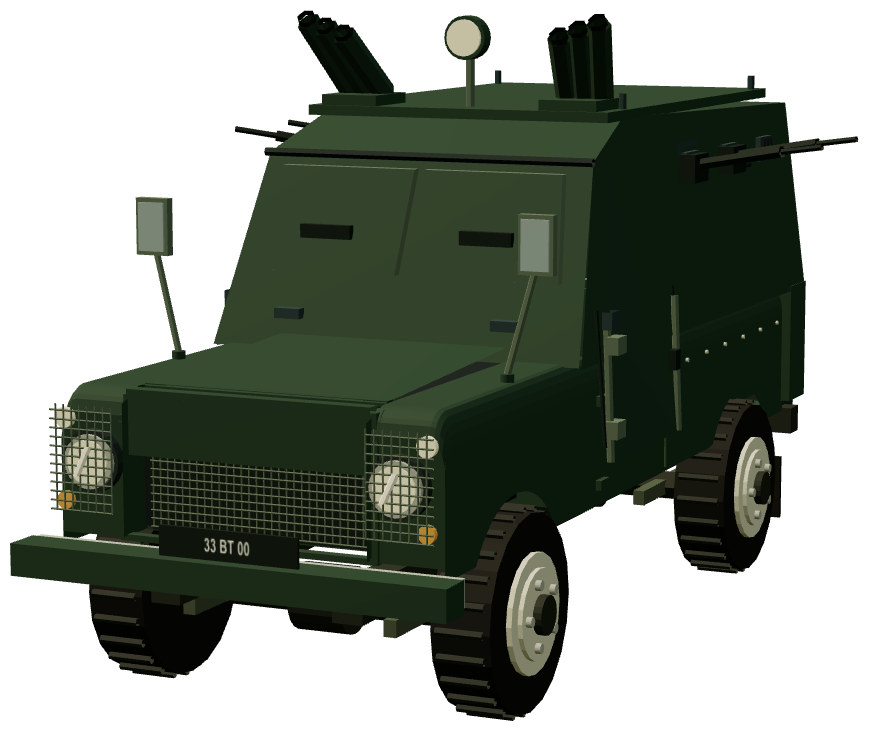
The first production Shorland Armoured Personnel Vehicle, marketed from 1974: a turretless, fully enclosed body on the Mark 3 Shorland's six-cylinder chassis, carrying a crew of eight behind eight gun ports with no powered ventilation at all. The RUC bought three in 1976 and the RAF Police also operated the type.
History
The SB.301 opened the production APV branch of the Shorland family — the enclosed personnel-carrying line that runs SB.301 to SB.401 to S-55, distinct from the turreted Mark 1-to-Mark 4 patrol cars. Short Brothers & Harland put it on the market in 1974, having built the turretless prototype (registered HOI 383) some years earlier. The designation is a company code and the Shorland Site decodes it: 'SB' for Shorts Brothers, '3' for the Mark 3 family of Shorlands on which it was based, and '01' as the model number signifying an APV. Bob Morrison adds that the number distinguished it from the SB.300, Shorts' internal designation for the original turreted Shorland APC.
Being a Mark 3 derivative gave it the Rover 2,625 cc six-cylinder petrol engine, which the Shorland Site notes was much needed to move a total crew of eight — driver, commander and up to six officers or troops in the rear. Unladen weight was 2,825 kg. In appearance it read as an angular, slightly taller long-wheelbase Land Rover riding higher on larger wheels and tyres, armoured from the engine bulkhead backwards with a GRP floor intended to absorb pipe-bomb blast. The cab doors were shallower than a civilian Land Rover's and carried replaceable laminated glazing blocks; instead of a two-piece windscreen there were two more large laminated blocks. Each rear body side and each of the twin rear doors held vision blocks that dropped to become firing ports. Its great weakness was air: there was no active ventilation, and fresh air could only be admitted through the eight gun ports and the hatches in the front doors when the situation allowed.
The Royal Ulster Constabulary was the type's best-documented British user. Shorts had developed the APV as a private venture hoping to sell it overseas; the RUC, wanting better ballistic protection than the appliqué glassfibre kits then being fitted to ordinary Land Rovers, obtained Home Office permission and bought three for evaluation. Bob Morrison dates the permission to 1975 and the purchase to 1976, and the Shorland Site records the three as supplied in 1976 — MOI 1007 is one of them, and MOI 2688 another that survived into a Lincolnshire vehicle graveyard by 2007. They arrived painted dark blue and were modified to RUC requirements, most visibly by deleting the windscreen visors and the armoured flaps over the side doors and substituting armoured glass. In service they were used mainly to move officers in and out of high-risk police stations, and were progressively modified thereafter, including with hinged 'flying pig' protective screens.
The SB.301 also served with the RAF Police: Bob Morrison photographed one in RAF Police markings at RAF St Mawgan in 1986, and the Shorland Site's FAQ confirms the RAF Police among Shorts' customers. Shorts marketed civil derivatives too — a cash and valuables carrier needed little modification from the standard body. Registration 33 BT 00 appears on a standard-configuration vehicle. Total SB.301 production is not published in any source consulted; Shorts' 1990 production figures were compiled by APC mark and do not break out the APVs. The SB.301 was superseded around 1980 by the V8-engined SB.401, which finally gained a roof extractor fan.
Registry record
- Manufacturer
- Short Brothers ↗& Harland Ltd, Belfast (Short Brothers from 1977)
- Manufactured
- on the market from 1974 (prototype usually dated 1973) until superseded by the V8 SB.401
- Modifier / coachbuilder
- Royal Ulster Constabulary vehicle workshops (modifications to the three RUC cars)
- Engine type
- Rover 2,625 cc six-cylinder petrol
- Production run
- Not published; Shorts' 1990 figures cover only the turreted marks. Three supplied to the RUC in 1976.
- Country of origin
- United Kingdom (Northern Ireland)
- Status
- out of production; withdrawn from RUC service, some survivors scrapped or derelict
Catalogue data
- Record kind
- Named model
- Model line
- Series III
- Wheels
- 4
- Nominal wheelbase
- 109″
Base catalogue fields are exported from the Difflocked game. In-game physics values are arcade tuning, not certified historical measurements, and are deliberately not shown as specifications here.
Sources & citations
Researched sources
- Shorland SB301 ↗ — The Shorland Site (accessed 2026-09-10)
- The History of Shorland Armoured Cars ↗ — The Shorland Site (accessed 2026-09-10)
- Shorland FAQ ↗ — The Shorland Site (accessed 2026-09-10)
- MLR26 — Short Brothers APV and Otokar ZPT ↗ — Joint Forces News (Bob Morrison) (accessed 2026-09-10)
- Police Armoured Land Rovers ~ Ulster Album ↗ — Joint Forces News (accessed 2026-09-10)
- Short Brothers ↗ — Wikipedia (accessed 2026-09-10)
Catalogue references
- https://shorlandsite.com/shorland-sb301/ https://shorlandsite.com/shorland-sb301/ ↗
Drive it
This vehicle is playable in the Difflocked racing game.
RACE THE SHORLAND SB301 APV ↗Registry record updated 2026-09-10T08:09:14.325Z · status: researched