Shorland Armoured Patrol
The Shorland Armoured Patrol Car was a turreted armoured car built by Short Brothers & Harland of Belfast on the long-wheelbase (109 in) Land Rover Series IIA chassis, developed for the Royal Ulster Constabulary and first delivered in 1966. More than 1,000 Shorlands of all marks were eventually built, with the early Mk1–Mk3 versions exported to police and military forces worldwide.
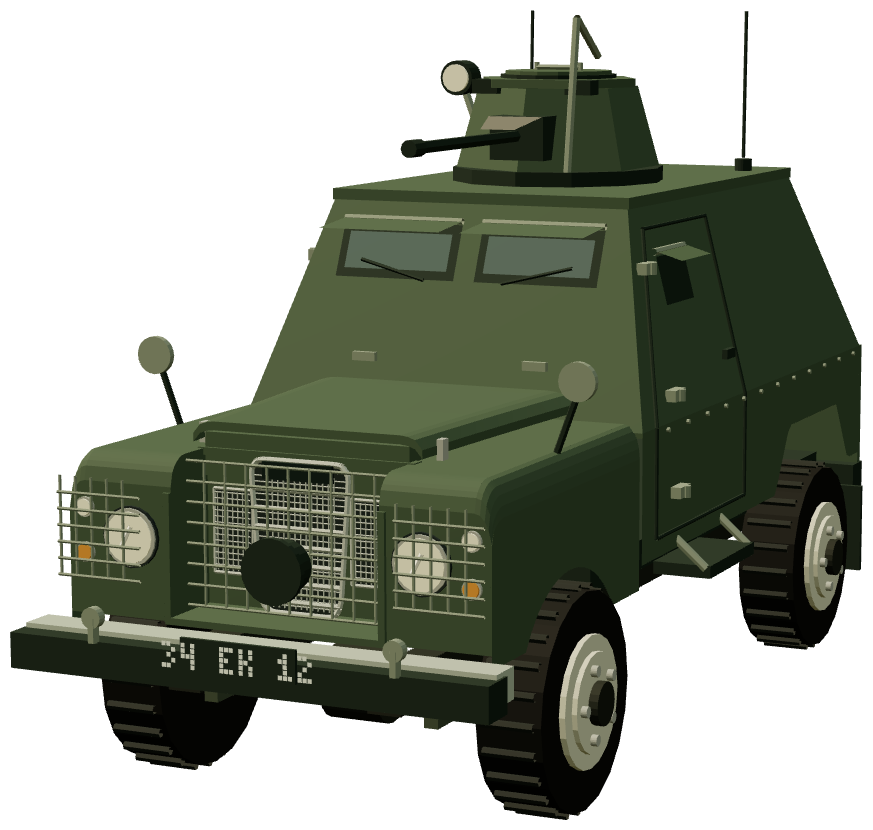
Factory colours
- RUC Green (satin emerald)
- Deep Bronze Green
- Olive Drab
Codes on hover. Hex values are representative approximations of period paint unless a source states a measured value.
History
The Shorland was conceived in the early 1960s after the Royal Ulster Constabulary asked for a vehicle suited to security duties and border patrols in Northern Ireland. Designed by Frederick Butler, with the first design meeting held in November 1961, the vehicle was developed by Short Brothers & Harland Ltd of Belfast — the aircraft manufacturer formed in 1947 when Short Brothers (Rochester and Bedford) Ltd merged with Short & Harland Ltd, the Belfast factory established in 1936 and half-owned by shipbuilder Harland & Wolff; the company reverted to the name Short Brothers in 1977. The third and final prototype was completed in 1964, production began in late 1965, and the first vehicle entered RUC service on 30 March 1966 wearing a civilian Belfast registration.
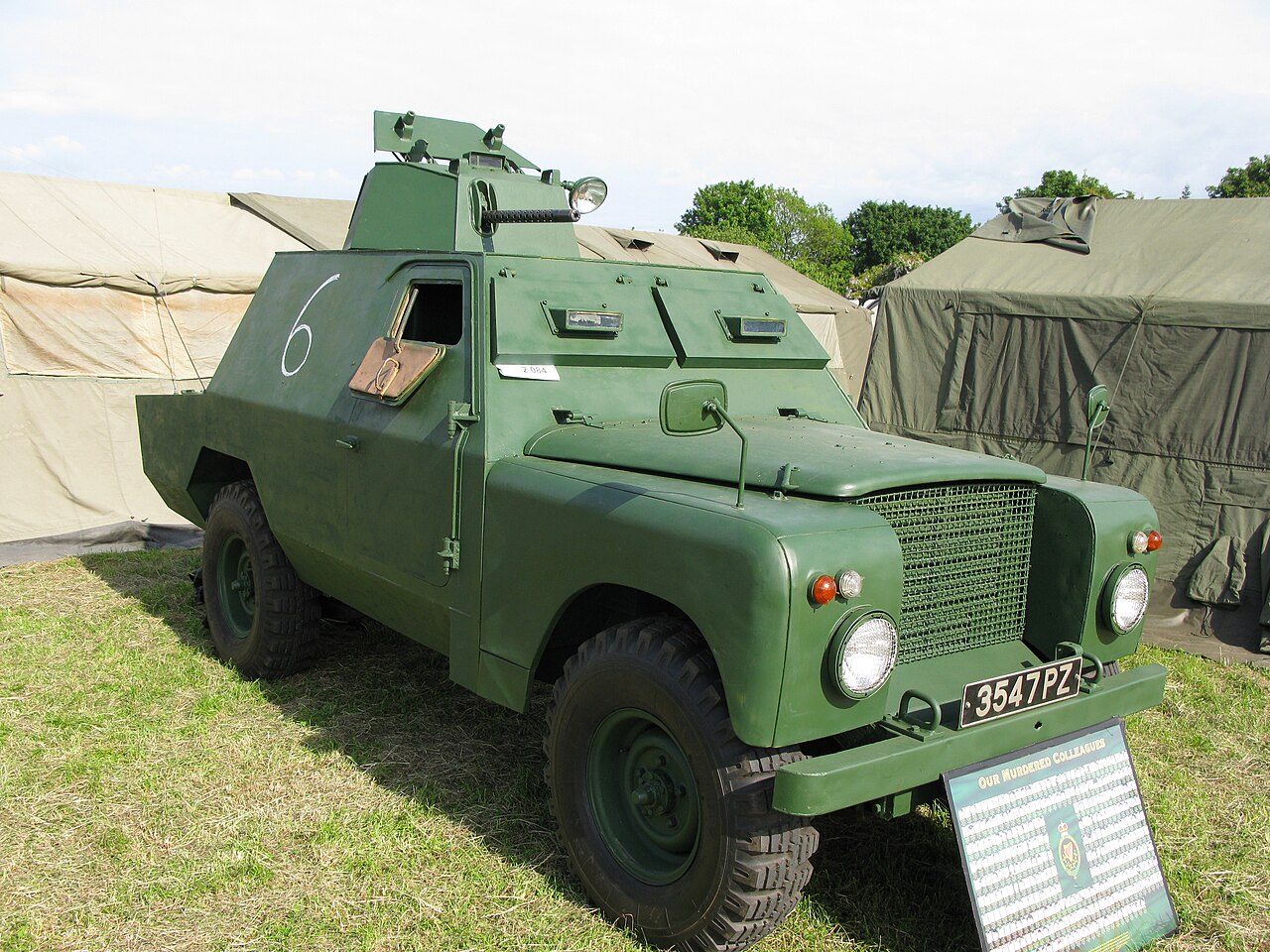
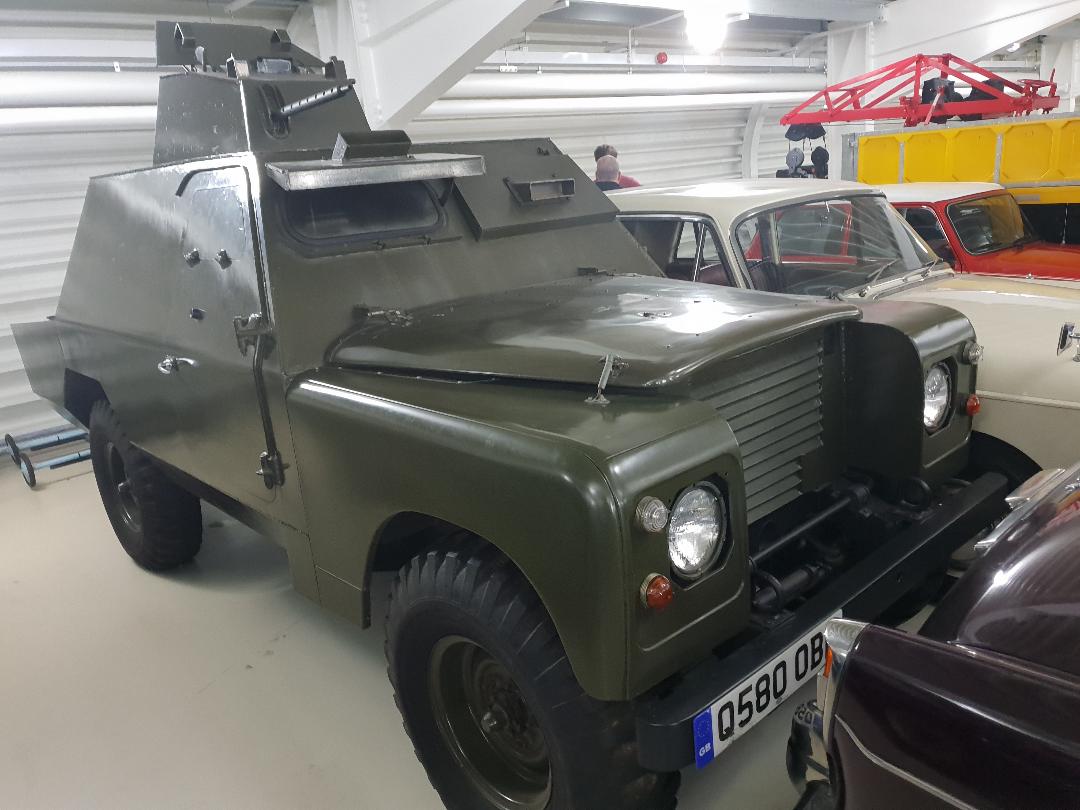
The design mated an armoured hull and a machine-gun turret to the 109-inch long-wheelbase Land Rover Series IIA chassis, fitted with heavy-duty axles and uprated suspension to carry the extra weight. The Mk1 carried armour plate 7.25 mm thick (Brinell hardness 363), and its rotating turret — similar in appearance to that of the Ferret Mk2 scout car — typically mounted a .30 in Browning machine gun. The crew was three. Around 100 Mk1s were built, powered by the Rover 2,286 cc four-cylinder petrol engine; the Mk2 (roughly 50 built) brought thicker 8.25 mm armour and a more powerful version of the four-cylinder engine, while the Mk3, introduced in 1972, used the 2.6-litre Rover six-cylinder petrol engine of 91 bhp and accounted for over 500 vehicles.
The Shorland became one of the most recognisable vehicles of the early Troubles. RUC Shorlands, painted emerald green, were deployed during the August 1969 riots in Belfast, where machine-gun fire from the vehicles proved highly controversial: nine-year-old Patrick Rooney, killed by Shorland machine-gun fire, was the first child to die in the violence. The RUC withdrew its Shorlands in January 1970, and the surviving vehicles were transferred to the newly formed Ulster Defence Regiment from April 1970, repainted deep bronze green with black disruptive striping and given military registrations. Shorland-derived vehicles remained in use on Northern Ireland's streets in small numbers as late as 1998.
The type was also a considerable export success. By the mid-1970s more than 400 had been sold to some 20 countries, and total production across all marks passed 1,000 vehicles by the 1980s. Operators included Iraq (72), Saudi Arabia (40), Portugal (38), Thailand (32), Lebanon (30), Argentina (20) and Malaysia (20), among more than 30 nations, and Shorlands saw action in the Lebanese Civil War, the Rhodesian Bush War and the Sri Lankan Civil War. An armoured personnel carrier derivative (the SB301/S52 series) was developed from the same hull.
Later development moved away from the Series Land Rover base: the Mk4 of 1980 adopted the 3.5-litre Rover V8, and the subsequent Series 5 (S5) family was built on the Land Rover Defender 110 chassis — those later vehicles are covered by a separate record. Short Brothers sold the complete Shorland design to British Aerospace Australia in 1996. Preserved early Shorlands survive in museums, including the ninth production vehicle at the Ulster Transport Museum and a 1967 example at the British Motor Museum, Gaydon.
Imagery

.jpg)
Registry record
- Manufacturer
- Short Brothers & Harland Ltd, Belfast (renamed Short Brothers Ltd in 1977)
- Manufactured
- 1965–c. 1980 (Mk1–Mk3; later marks continued into the 1990s)
- Modifier / coachbuilder
- Short Brothers & Harland ↗
- Engine type
- Rover 2.25 L (2,286 cc) petrol inline-four, 67–77 bhp (Mk1–Mk2); Rover 2.6 L petrol inline-six, 91 bhp (Mk3)
- Production run
- ~650 Mk1–Mk3 (Mk1 ~100, Mk2 ~50, Mk3 500+); over 1,000 across all marks
- Country of origin
- United Kingdom (Northern Ireland)
- Status
- out of production; preserved examples in museums
Catalogue data
- Record kind
- Named model
- Model line
- Series IIA
- Wheels
- 4
Base catalogue fields are exported from the Difflocked game. In-game physics values are arcade tuning, not certified historical measurements, and are deliberately not shown as specifications here.
Sources & citations
Researched sources
- Shorland armoured car ↗ — Wikipedia (accessed 2026-09-09)
- The History of Shorland Armoured Cars ↗ — The Shorland Site (accessed 2026-09-09)
- Shorland Armoured Patrol Car Mark 1 ↗ — The Shorland Site (accessed 2026-09-09)
- The Shorland ↗ — Ulster Transport Museum (National Museums NI) (accessed 2026-09-09)
- Shorland Armoured Patrol Vehicle ↗ — Gun Mart (accessed 2026-09-09)
- Short Brothers ↗ — Wikipedia (accessed 2026-09-09)
Development reference notes
Shorland Mk III · MILITARY-MODEL-REFERENCES.md
- [Clive Elliott's Shorland archive](https://old.shorlandsite.com/CarMark3.htm): period literature, hull shape, vision shutters, turret and wire cutter references. - [Christophe Jacquemont's photographic walkaround](https://warwheels.net/Shorland3apcPortJacquemont.html): detailed door hinges, armoured windscreen shutters, headlamp guards, turret hatch, mantlet and spotlight. The model retains military green rather than copying the photographed Portuguese police livery. The armour-gap fixes join each cab's lower scuttle, door panels and headers before the Defender proportion transform runs. Pulse side-cross artwork scales uniformly around its centre, preserving equal arms instead of stretching with the rear body.
[Clive Elliott's Shorland archive](https://old.shorlandsite.com/CarMark3.htm): period literature, hull shape, vision shutters, turret and wire cutter references. · MILITARY-MODEL-REFERENCES.md
- [Clive Elliott's Shorland archive](https://old.shorlandsite.com/CarMark3.htm): period literature, hull shape, vision shutters, turret and wire cutter references.
[Christophe Jacquemont's photographic walkaround](https://warwheels.net/Shorland3apcPortJacquemont.html): detailed door hinges, armoured windscreen shutters, headlamp guards, turret hatch, mantlet and spotlight. The model retains military green rather than copying the photographed Portuguese police livery. · MILITARY-MODEL-REFERENCES.md
- [Christophe Jacquemont's photographic walkaround](https://warwheels.net/Shorland3apcPortJacquemont.html): detailed door hinges, armoured windscreen shutters, headlamp guards, turret hatch, mantlet and spotlight. The model retains military green rather than copying the photographed Portuguese police livery.
Shorland · MILITARY-REFERENCES.md
- Shorland: https://dunsfoldcollection.co.uk/collection/shorland/ — Series IIA 109 chassis, sloping armour and turret.
Drive it
This vehicle is playable in the Difflocked racing game.
RACE THE SHORLAND ARMOURED PATROL ↗Registry record updated 2026-09-09T05:01:02.028Z · status: researched