Vickers Hover Rover
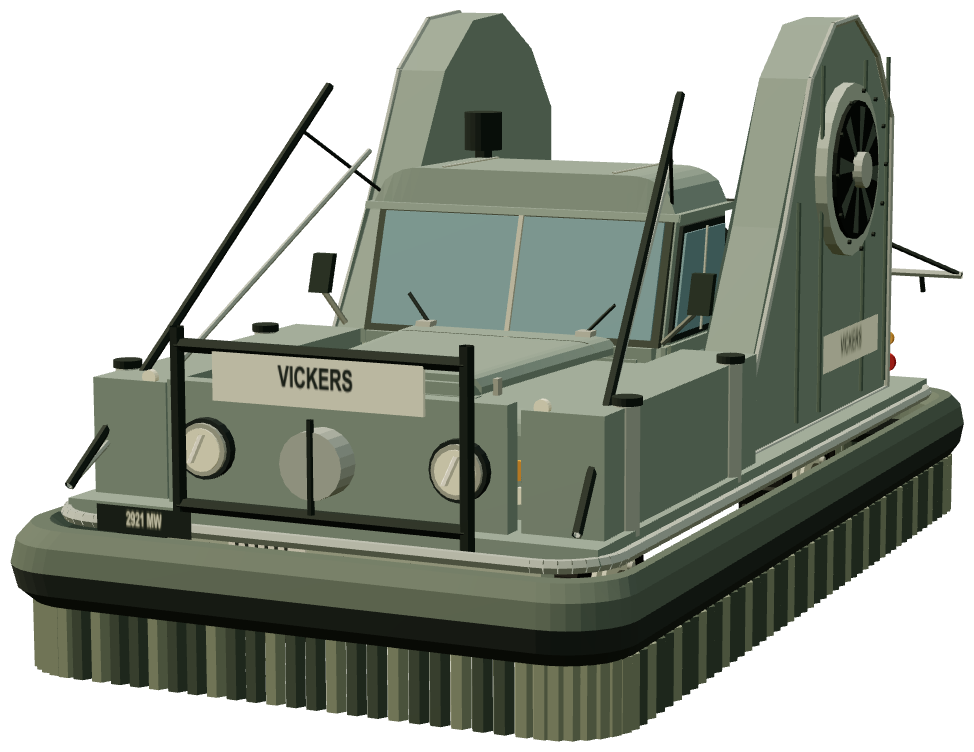
Vickers-Armstrongs' 1962 experimental air-cushion Land Rover: a hovercraft-style skirt and fan conversion, demonstrated at South Marston, that part-supported the vehicle on an air cushion while its wheels kept traction.
History
The Hover Rover was built by hovercraft maker Vickers-Armstrongs at its South Marston works near Swindon, in parallel with the company's full-size hovercraft programme of the early 1960s. It took a standard long-wheelbase Land Rover and added extended bodywork, lift fans and a large flexible skirt around the lower body. The skirt could be raised so the vehicle travelled normally on its wheels, or lowered so the air cushion carried most of the weight, leaving the lightly loaded wheels to provide traction and steering over soft ground. Vickers pitched the system as an aftermarket 'hovercraft conversion kit' that could in principle be fitted to any vehicle, and demonstrated it to the press at South Marston in April 1962; British Pathe filmed it skimming over rough, swampy ground the same year.
The application actually trialled was agricultural crop spraying, where the vehicle's minimal ground pressure promised to protect soft fields. It failed in practice: air escaping from the cushion scattered the spray uncontrollably, and the conversion's added machinery cut heavily into payload. The Hover Rover was never developed further, though Vickers kept it for a few years as a promotional curiosity for its larger hovercraft. Only the single demonstrator is documented, and its ultimate fate is not recorded in the sources consulted; period accounts differ on details such as whether the fans ran off the Land Rover's own engine (as bartiesworld.co.uk describes) or required a separate engine.
Registry record
- Manufacturer
- Land Rover (The Rover Company) — donor vehicle
- Manufactured
- 1962 conversion
- Modifier / coachbuilder
- Vickers-Armstrongs (South Marston works)
- Production run
- 1 demonstrator documented
- Country of origin
- United Kingdom
- Status
- not developed beyond the demonstrator; fate unrecorded
Catalogue data
- Record kind
- Named model
- Model line
- Series IIA
- Wheels
- 4
Base catalogue fields are exported from the Difflocked game. In-game physics values are arcade tuning, not certified historical measurements, and are deliberately not shown as specifications here.
Sources & citations
Researched sources
- Vickers Armstrong hovercraft of the early 1960s (Hover Rover: two fans driven from the standard engine; skirt raised for road travel or lowered leaving the wheels lightly loaded) ↗ — Bartie's World (accessed 2026-09-10)
- Hover Rover (1962) — newsreel of the Vickers air-cushion Land Rover filmed near Swindon ↗ — British Pathé (accessed 2026-09-10)
- The Land Rover History: Special Projects (Hover Rover developed to minimise ground pressures; crop-spray trial failed as cushion air scattered the spray; used as promotion for Vickers' larger hovercraft) ↗ — Winwaed / mapping-tools.com (accessed 2026-09-10)
- Apr. 11, 1962 - Hovercraft assisted Land Rover for rough going (period press photo caption: Vickers demonstration at South Marston of the crop-spraying 'air cushion' conversion) ↗ — Alamy (period press caption) (accessed 2026-09-10)
- Hover Rover — Forsyth's Compendium of Curious Contraptions (Vickers plant at South Marston, Swindon; skirt proposed as an aftermarket conversion for 'any vehicle') ↗ — feorag.wordpress.com (accessed 2026-09-10)
Catalogue references
- https://www.bartiesworld.co.uk/hovercraft/vickers.php https://www.bartiesworld.co.uk/hovercraft/vickers.php ↗
Development reference notes
Vickers Hover Rover · HERITAGE-FLEET-REFERENCES.md
Huge flexible skirt around the lower body; added fan equipment; ordinary cab above. Reference: https://www.bartiesworld.co.uk/hovercraft/vickers.php
Drive it
This vehicle is playable in the Difflocked racing game.
RACE THE VICKERS HOVER ROVER ↗Registry record updated 2026-09-09T19:57:49.717Z · status: researched