Vickers-Armstrongs
One of Britain's largest armaments and engineering conglomerates, formed in 1927 by merging Vickers Limited with Sir W. G. Armstrong Whitworth & Company and building warships, tanks, aircraft, guns and steel until nationalisation broke it up. Its hovercraft division at South Marston near Swindon built the VA-1, VA-2 and VA-3 craft of the early 1960s and, in 1962, the experimental air-cushion Hover Rover.
History
Vickers-Armstrongs Limited was created in 1927 from the assets of Vickers Limited and Sir W. G. Armstrong Whitworth & Company, with Vickers holding two thirds of the shares; the head office was at Vickers House, Westminster, and the great works were the Elswick and Scotswood plants on the Tyne, the Barrow and Walker-on-Tyne shipyards and, from 1928, Supermarine at Southampton. By 1935, before rearmament began in earnest, it was the third-largest manufacturing employer in Britain after Unilever and ICI. It built Spitfires, Wellingtons and Warwicks — the company's aircraft output between 1911 and 1970 exceeded 16,000 machines — along with tanks, naval guns, submarines, liners and steel.
The aviation business was reorganised at government request as Vickers-Armstrongs (Aircraft) Ltd in 1939, and the company took over South Marston airfield near Swindon in 1945 as a base for Supermarine. South Marston is where the hovercraft work happened. Vickers entered the field around 1960-61 — accounts differ on whether the plywood VA-1 experimental craft appeared in 1960 or 1961 — and followed it with the five-seat VA-2 and, from a build begun in March 1961, the 56-foot VA-3, which on 20 July 1962 opened the world's first commercial hovercraft passenger service, running for British United Airways across the Dee estuary between Rhyl and Wallasey. A trials base on the Itchen at Southampton supported the programme.
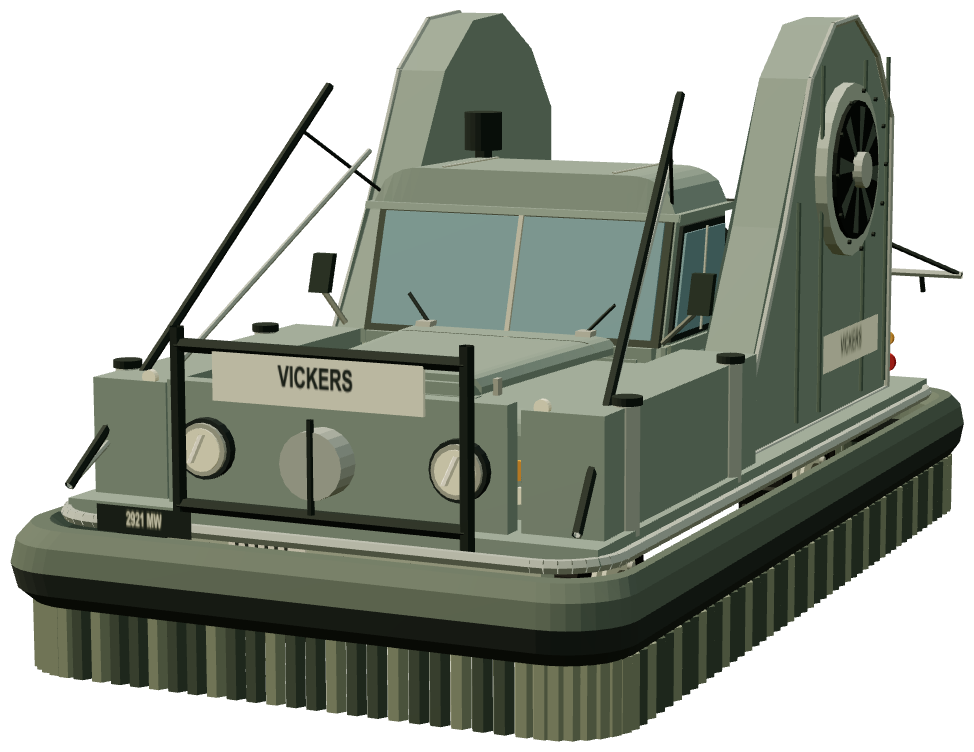
The Hover Rover was a sideline of that work. In 1962 the South Marston team fitted a long-wheelbase Land Rover with lift fans, extended bodywork and a large flexible skirt: raised, the vehicle ran normally on its wheels; lowered, the air cushion took most of the weight and left the lightly loaded wheels to provide traction and steering over soft ground. Vickers pitched it as a hovercraft conversion kit for any vehicle and demonstrated it to the press at South Marston in April 1962, trialling it for crop spraying — an application that failed because escaping cushion air scattered the spray. The single demonstrator was kept for a few years as promotion for the company's larger craft and went no further.
The conglomerate did not outlive the decade in its old form. The aircraft interests went into the British Aircraft Corporation in 1960, ending the Vickers-Armstrongs name in aviation; the hovercraft business was merged with Westland's in 1966 to form the British Hovercraft Corporation; the shipbuilding division, renamed Vickers Armstrongs Shipbuilders in 1955 and the Vickers Limited Shipbuilding Group in 1968, was nationalised into British Shipbuilders in 1977, as the steel interests had been into British Steel. What was left was divested as Vickers plc in 1977. The South Marston site later became Honda's British car plant, which itself closed in 2021.
Imagery

Vehicles in this registry (1)


Sources & citations
- Vickers-Armstrongs (formed 1927 from Vickers Ltd and Sir W G Armstrong Whitworth; third-largest British manufacturing employer by 1935; over 16,000 aircraft 1911-1970; aircraft into BAC 1960; shipbuilding and steel nationalised; residue divested as Vickers plc in 1977) ↗ — Wikipedia (accessed 2026-09-10)
- Vickers-Armstrongs (1927 merger with Vickers holding two thirds; head office Vickers House, Westminster; Elswick Works; Vickers-Armstrongs (Aircraft) Ltd formed 1939; South Marston airfield acquired 1945 for Supermarine; the Vickers-Armstrongs name ceased in aviation with the 1960 formation of BAC) ↗ — Grace's Guide to British Industrial History (accessed 2026-09-10)
- Vickers Armstrong hovercraft of the early 1960s (entered the field October 1961 at South Marston, Swindon, with a trials base on the Itchen; VA-1 plywood experimental craft, VA-2 five-seater, VA-3 56-foot passenger craft running the world's first commercial hovercraft service from 20 July 1962; the Hover Rover; hovercraft merged with Westland to form the British Hovercraft Corporation in 1966) ↗ — Bartie's World (accessed 2026-09-10)
- Vickers-Armstrongs VA-3 (build begun March 1961, trials April 1962; British United Airways Rhyl-Wallasey service across the Dee estuary) ↗ — Wikipedia (accessed 2026-09-10)
- Apr. 11, 1962 - Hovercraft assisted Land Rover for rough going (period press caption: Vickers demonstration at South Marston of the crop-spraying air-cushion conversion) ↗ — Alamy (period press caption) (accessed 2026-09-10)
Maker record updated 2026-09-10T05:17:07.280Z · status: researched